”Feng Shui Modern” by Cliff Tan: A Personalised Summary
1. Feng Shui (lit. ‘Wind and Water’)
Foundational type of Feng Shui is called San He, or the Form School.
This is based on the physical world.
San Yuan, or the Compass School, is a more complex form requiring calculation based on the date of birth, and the like.
Feng Shui is 3,000 years old and was first used to help a Chinese emperor build a new city.
Feng Shui gives you the right environment in which to optimise your own performance to achieve your goals, but it cannot guarantee any specific outcome.
Let how you feel be your ultimate guide.
2. Foundations
Destiny is determined by
(1) Heaven - all out of control
(2) Self - all within control
(3) Environment - can be made within one’s control
2.1 Yin and Yang
Before the beginning of time, there was wu ji (“Nothingness” but also meaning “Promise”). Wu ji is represented by a perfect circle. This circle might look empty, as it represent nothing - but it is also full, and contains everything there is.
A dot appears inside this circle.
This is the seed of being, and from this comes a spark that divides the boundless circle down the middle. This split creates heaven and earth, the sky and the ground, light and darkness.
These opposites are represented in the circle by one half being white, and the other being black. You can’t have one without the other.
This is Yin and Yang. Yin is black and Yang is white. Yin is calm. Yang is energy.
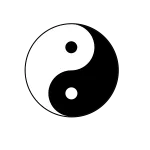
This final symbol is known as tai ji
Yang would be a candle in a dark room. But that light would be dark and yin compared to the sun.
Feng Shui is the balance of Yin and Yang.
| Aspect | Yin | Yang |
|---|---|---|
| Color | Black | White |
| Nature | calm, receptive, passive | energetic, active, assertive |
| Symbolic Examples | night, moon, water, softness | day, sun, fire, hardness |
| Associated Elements | earth, water, winter | fire, air, summer |
| Movement | downward, inward | upward, outward |
2.2 Ba Gua
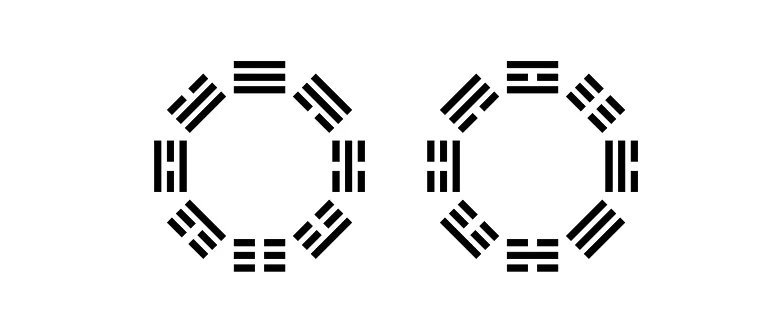
The understanding that everything is either Yin or Yang led to the creation of the Ba Gua, a system of solid and broken lines that appear in eight combinations of three rows, known as trigrams.
Yin is a broken line. Yang is a sold line. Three broken lines is full Yin. Three solid lines is full Yang. And there are combinations.
The position of the trigrams in the circle changes the way they interact. For example, if you place the combination of three solid lines opposite the combination of three broken lines, you achieve total balance. It’s like placing fire opposite water, or black opposite white. This Ba Gua arrangement (above left), where opposites balance, is ordered and sensible, and is known as the Earlier Heaven Sequence.
There is another version of the Ba Gua, known as the Later Heaven Sequence intended to represent the real world and how relationships are not defined by opposites. In this version (above right), the locations of the trigrams are mixed up. It teaches us that a space does not always have to be perfectly balanced to be beautiful – sometimes a room that is dark with just a touch of light is all we need. This is the Ba Gua sequence we most commonly use in the practice of Feng Shui.
Everything in the world has qualities of Yin or Yang, and often a combination of both.
2.3 Five Elements
Chinese philosophy gives us five symbolic elements:
Fire☲ Earth☷ Metal☶ Water☵ Wood☴
| Element | Direction | Season | Colour(s) | Shape | Primary quality | Yin/Yang aspect |
|---|---|---|---|---|---|---|
| Fire 🔥 |
South | Summer | Red / Orange | Triangle 🔺 |
Heat & energy, upward‑rising | Yang (bright, hot) / Yin (smouldering) |
| Earth 🌍 |
Centre | — (seasonless) | Yellow / Brown | Square 🟫 |
Balance & grounding, stillness | Yang (fertile, supportive) / Yin (stable, receptive) |
| Metal 🛞 |
West | Autumn | White | Circle ⚪️ |
Malleability & density, inward‑spinning | Yang (sharp, expansive) / Yin (solid, reflective) |
| Water 💧 |
North | Winter | Black / Deep‑blue | Shapeless 🌊 |
Fluidity, downward flow | Yang (flowing, energetic) / Yin (still, nourishing) |
| Wood 🌳 |
East | Spring | Green / Light‑blue | Rectangle ▭ |
Growth, outward expansion | Yang (growing, active) / Yin (dormant, rooted) |
Yin and yang and the elements represent physical things.
2.4 Energy – Chi
Chi (lit. “air’) is non-physical feelings, flow and energy that we intuit from the world around us.
It is a fundamental concept of Feng Shui. It’s the sense that a room feels right or not.
Chi comes in different forms classified as movement, light and air, sharp edges, and ambiance. The following forms of chi are found in almost any space.
Life (Sheng) Chi is growth, happy thoughts, a gentle breeze, plants. It breathes life into a space. This is not the same as light, and it may exist within darkness. A lush, dense forest is full of this Chi. Light and air are the chi that comes from windows, sunlight, breezes. It’s easy to confuse this form of chi with movement Chi, especially if a room has, say, French windows, which bring both light and circulation. In this case, light, air and movement co-exist.
Dead (Si) Chi is a stagnant stillness, like when you enter an abandoned home that has a musty smell. A space does not need to be dark to have dead Chi – you can just as easily find it in a desert without any wind.
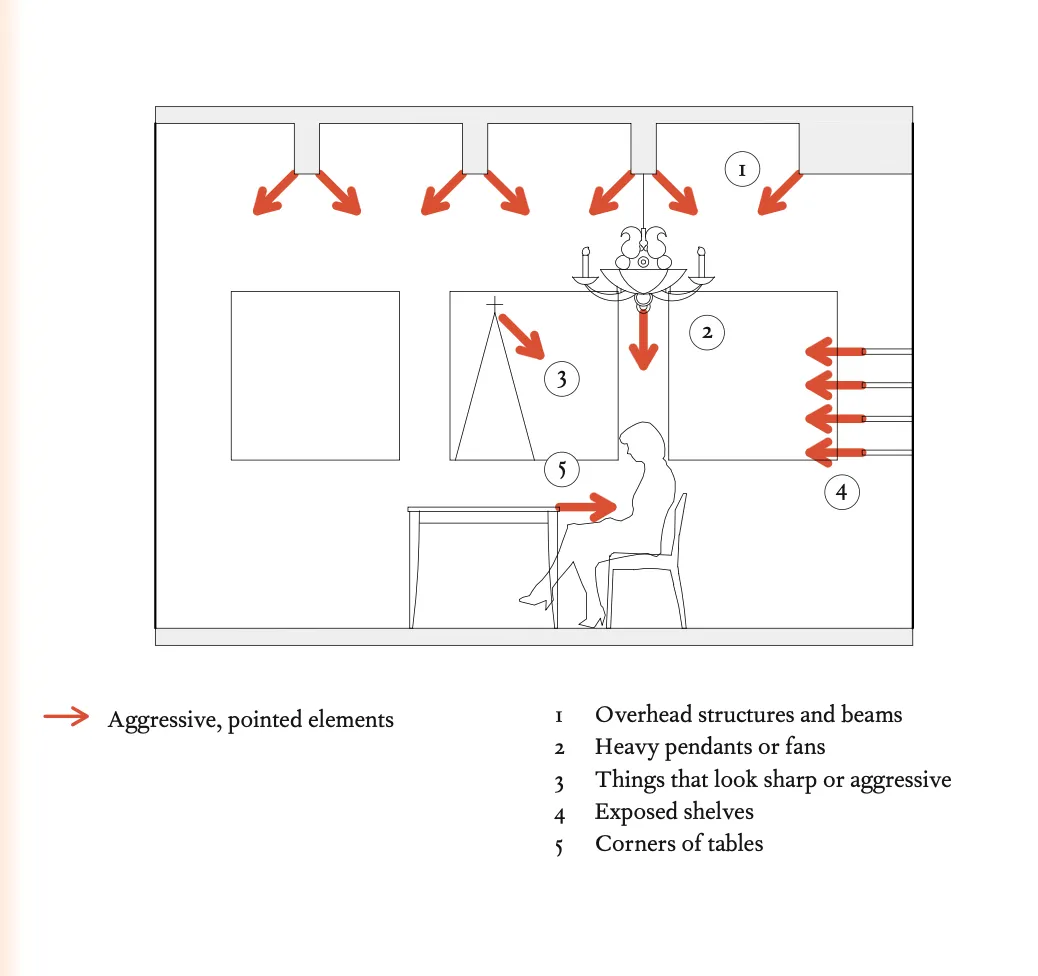
Killing (Sha) Chi is a threatening, uncomfortable feeling, like a knife pointing towards you, and is the Chi that we affect when we position our furniture. This type is directional and it affects only the person it is pointed towards. Sharp edges are physical structures within your line of sight. These may be the sharp corners of buildings, overhead beams, hanging lights or sloped ceilings. Even though these objects have no actual impact on you, they are oppressive and have a weight. The sharpness of the angle affects the hostility of this kind of Chi.
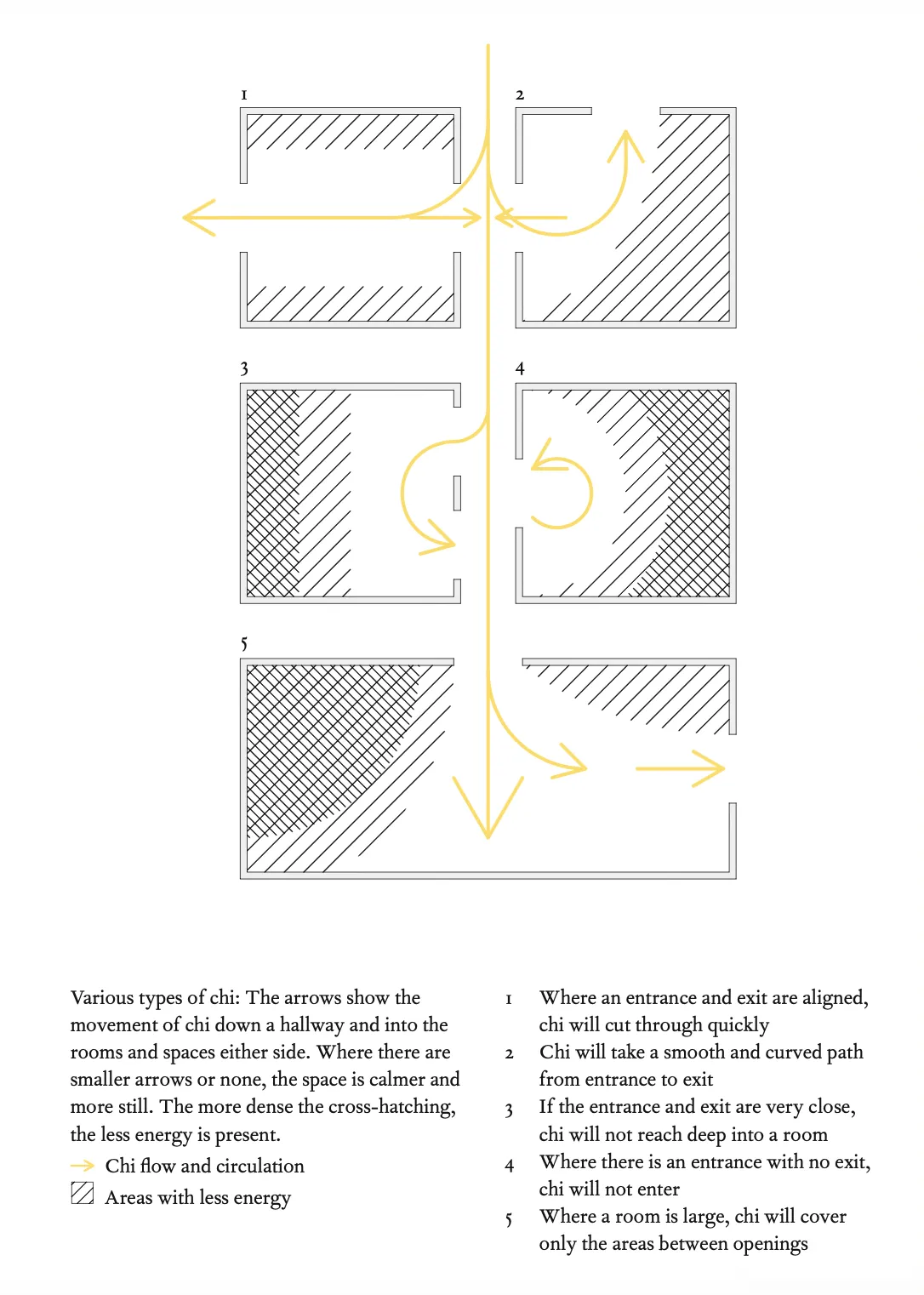
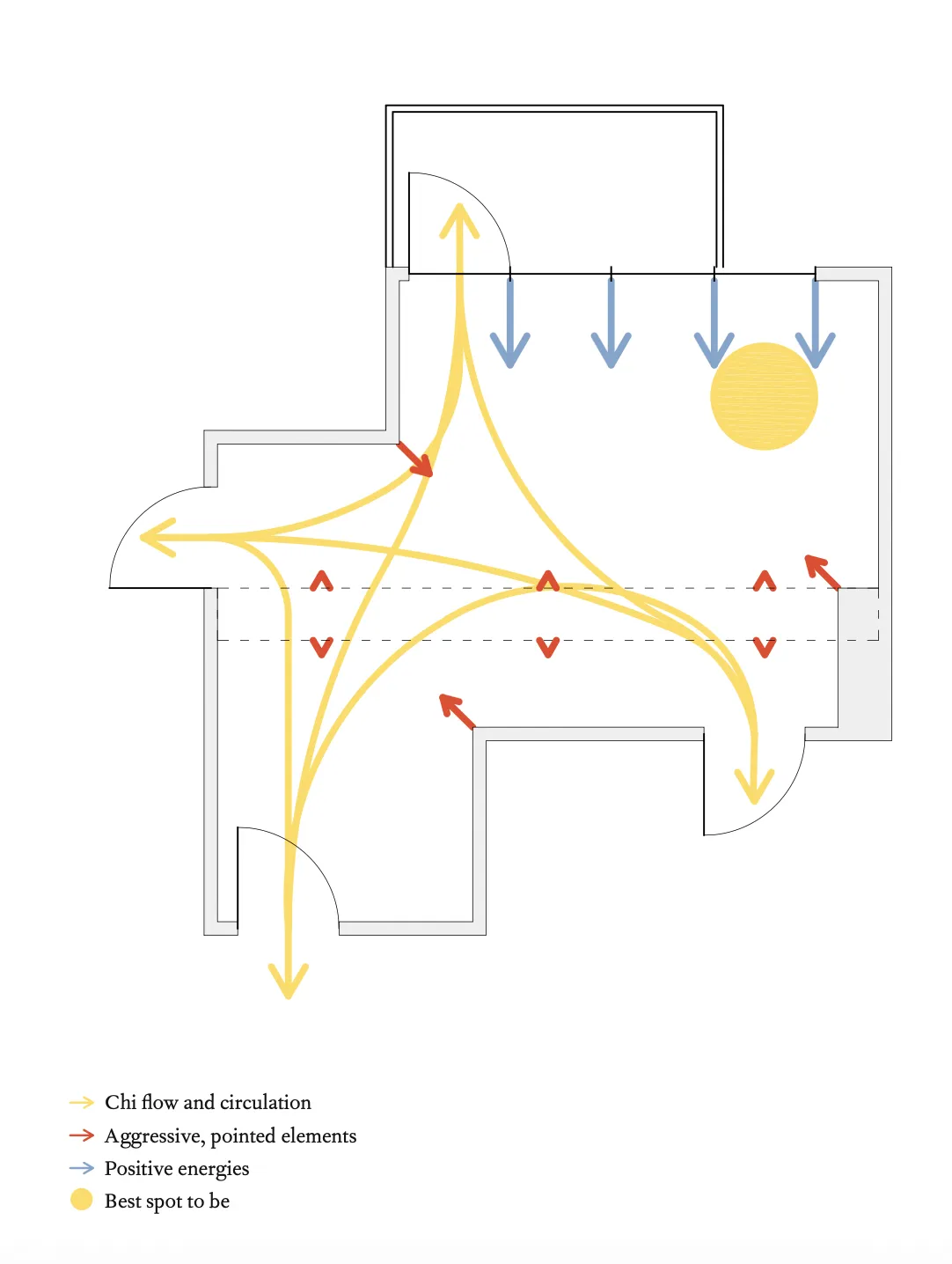
- Movement (Dong) Chi is about the physical circulation of chi in a space, such as through long corridors, passages and walkways. To identify how movement Chi acts in any given space, you just need a floorplan that enables you to locate all the passages, corridors, stairs and high-traffic areas. Effectively, the longer a straight corridor, the stronger the Chi, which is bad for a sleeping space, but good for a business. Rooms with no windows usually have no movement Chi at all. Chi cannot flow in and out of the same opening. Ideally a room should have one door and one window on different walls.
The ambiance of a place may be created by a combination of all the types of Chi, and it may depend upon a person’s memories of or associations with a place. For example, a cemetery has very strong Yin Chi owing to its links with death but that’s not to say that some people wouldn’t find a sense of peace among the dead. The point is that when you are deciding the ambiance and chi levels of a place, it really depends on how you feel about it. Other things, such as clutter, colour and the balance of the elements also affect ambiance.
Feng Shui generally prefers gentle curves rather than straight lines in order to balance movement Chi.
2.5 Five Animals
In Feng Shui, everything has Five Aspects: Front, Rear, Left, Right, Centre.
These are represented by the Five Animals.
Each has a certain need you should fulfil. They aren’t separate creatures hanging around you or your space, but are, in fact, a part of you and your own senses, and they influence how you react to your surroundings.
Tortoise 🐢 (north)
The Tortoise a.k.a the Black Tortoise is associated with water, and a strong shell that represents our need for stable support. The Tortoise should always be behind us, protecting us in a room, this usually means having a wall at our back. The direction of the Tortoise is North, because that’s the direction our back is facing when we look towards the Sunny South.
Bird 🦢 (south)
The Bird a.k.a the Vermillion Bird or Phoenix is associated with Fire and has broad wings and far-reaching sight. It asks that you have space in front of you, and ideally Water (representing life). The direction of the Bird is facing the South, because that is the direction of the Sun.
Dragon 🐉 (east)
The Dragon a.k.a the Azure Dragon is associated with Wood and has powerful Yang energy and represents growth. The direction of the Dragon is to the East, where the Sun rises every day and where good fortune is said to come from. The Dragon is about encouraging positive energy and fresh vitality.
Tiger 🐯 (west)
The Tiger a.k.a the White Tiger is associated with Metal. Its powerful body is able to protect the positive energy of the Dragon, in particular. The direction of the Tiger is to the West, where the Sun sets and Day turns to Night. Here, the tiger can detect any inconsistencies in energy, and offer balance and fortitude.
Snake 🐍 (centre)
The Snake is associated with Earth. It has no direction – rather, it forms the central anchor for the other four Animals, sitting in the middle of them. It represents our need for balance. Essentially, the Snake is your mental state and, while it is important to fulfil the requirements of the other four Animals, overall wellbeing relies upon a sense of balance in mind. If something feels amiss in a room, even if you have fulfilled all the other requirements of Feng Shui, then it probably is.
| Animal | Direction | Element | Key Need |
|---|---|---|---|
| Tortoise 🐢 |
North | Water | Stable support – a solid “wall” behind you |
| Bird 🦢 |
South | Fire | Open space in front of you, ideally with water (life) |
| Dragon 🐉 |
East | Wood | Growth‑boosting Yang energy; fresh vitality |
| Tiger 🐯 |
West | Metal | Protection of the Dragon’s energy; balance & fortitude |
| Snake 🐍 |
Centre | Earth | Central anchor; mental balance and overall wellbeing |
3. Application
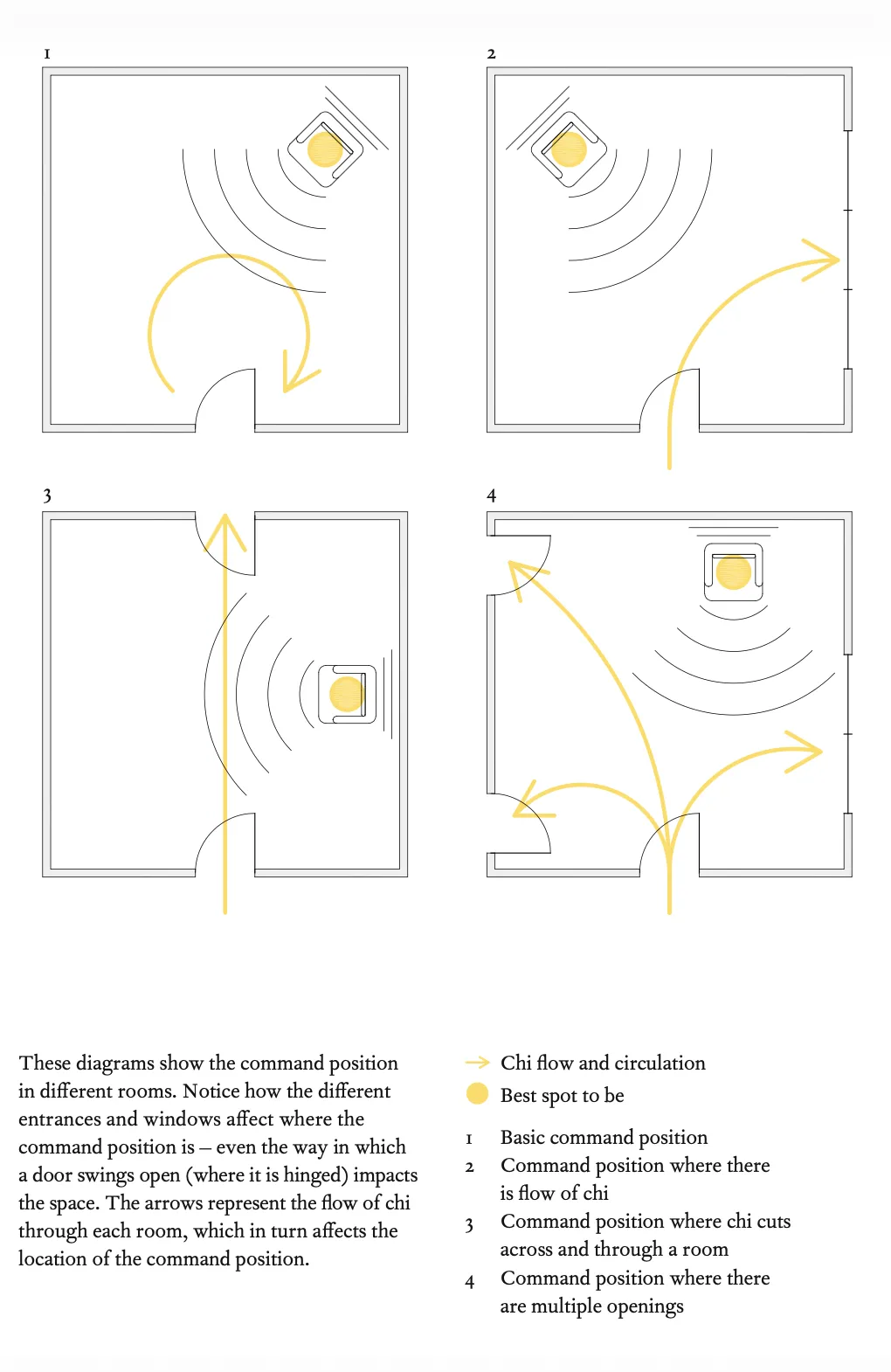
3.1 The Command Position
This is a position that gives a feeling of security and satisfaction.
The Snake is you in the space.
The Tortoise with its hard shell representing protection and stability is behind you. This feeling is manifested through a wall or a stable structure, like a back rest. Avoid sitting with your back to a window or door as there positions can lead to feelings of insecurity.
The Bird with its wings ready for flight into the open is in front of you. Avoid facing blocked views.
The Dragon and the Tiger are at your sides like two arms of a comfortable chair. The Dragon is for growth and the Tiger is for defence.
3.2 Flow and Chi
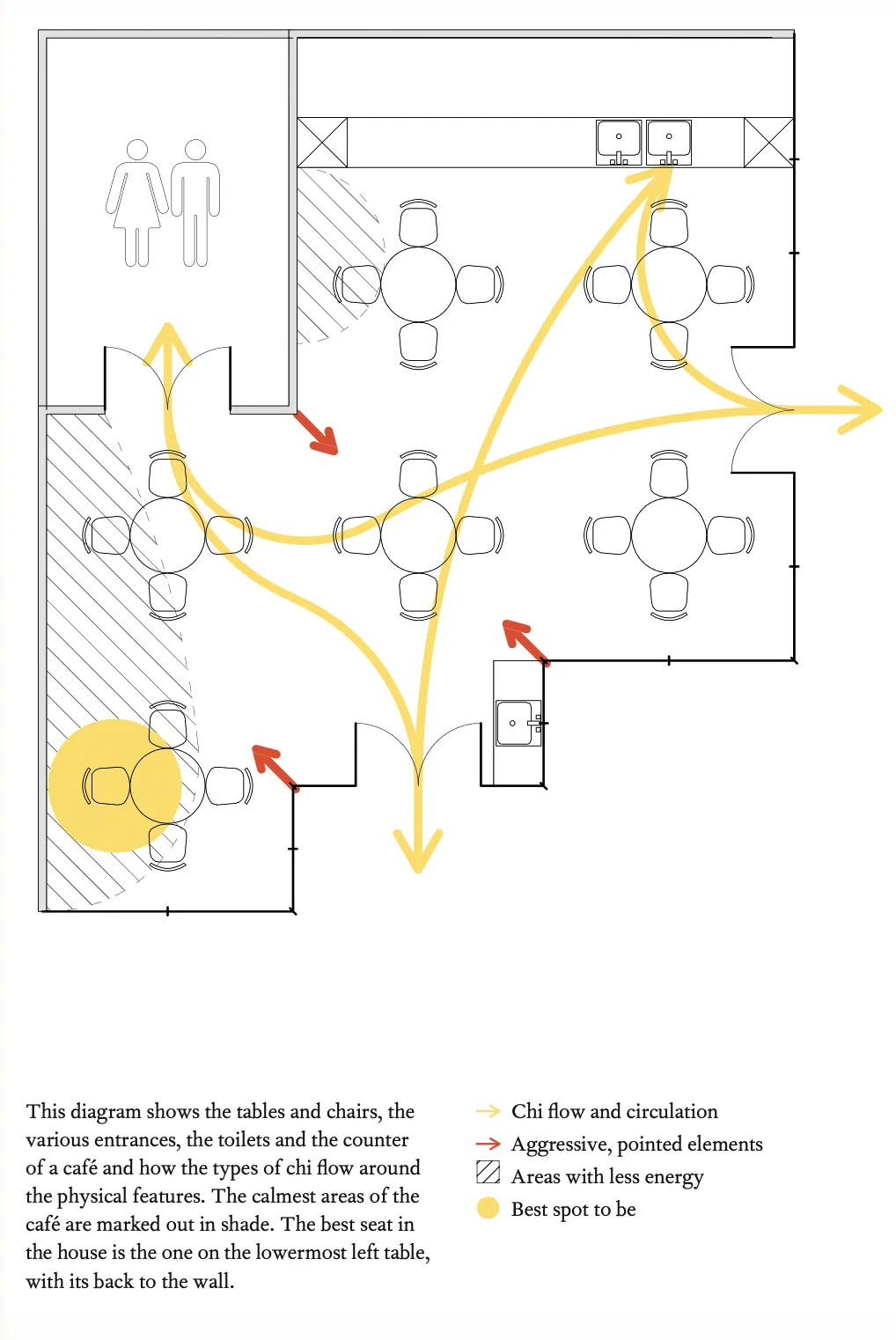
Chi is often described as the energy of a space, but what it really refers to is the feeling that you have while being in a space. Being in a command position may offer you protection, but it does not change how the space may feel around you.
Length provides a sense of movement and control. Being underneath an object causes a sense of trepidation and discomfort. Proximity to objects that may cause harm like sharp corners cause unease.
3.3 The Balance of the Five Elements
Creating beautiful space is about a methodical awareness of the environment and establishing balance so that the space not only looks nice, but feels right, too.
This is done in two stages:
- Analyse environment - how the natural elements affect the space
- Look at the balance of the physical elements in the space
The direction of your room affects your environment and its dominant element, but the size of your window and whether or not there are trees or buildings outside that block the view will also have their own effects. In the Southern Hemisphere, the Sun is in the North, and the direction for Summer, and South for Winter.
| Direction | Season | Light | Rooms | Decor |
|---|---|---|---|---|
| North | Winter | calm, blue, indirect, regular, neutral | office, studio | warm Yang colours; avoid window coverings; stronger night lighting |
| South | Summer | strong and sensual | public rooms | vibrant colours and soft ambient lighting; hardy plants will absorb and soften strong chi |
| East | Spring | mild, cool, warming, rejuvenating | children bedroom or conservatories | wood growth elements; warmer tones and slightly stronger lighting |
| West | Autumn | red, orange | adult bedrooms | cooler colours and soft lighting |
Balance Elements throughout each space in your home
3.4 The Element Cycles
The Five Elements are always interconnected, and where there is one, there should always be the other four. Also factor in personality as part of balance.
Balance does not always require opposites. A dark, cold Water space need not be counterbalanced with Fire red triangles but Earth-toned flooring for base, Metal Orbs, and Wood in the form of plants.
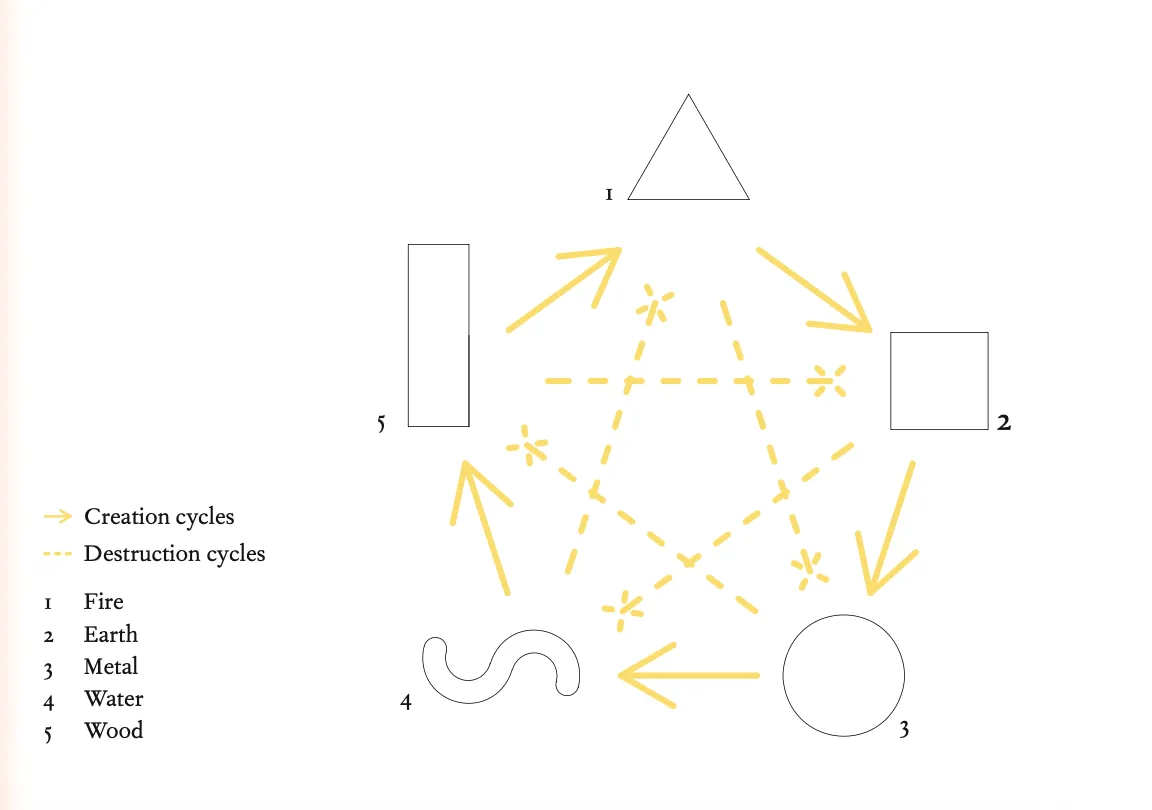
The cycles are just a means to guide you to create compositions that might have more harmony.
4. Planning
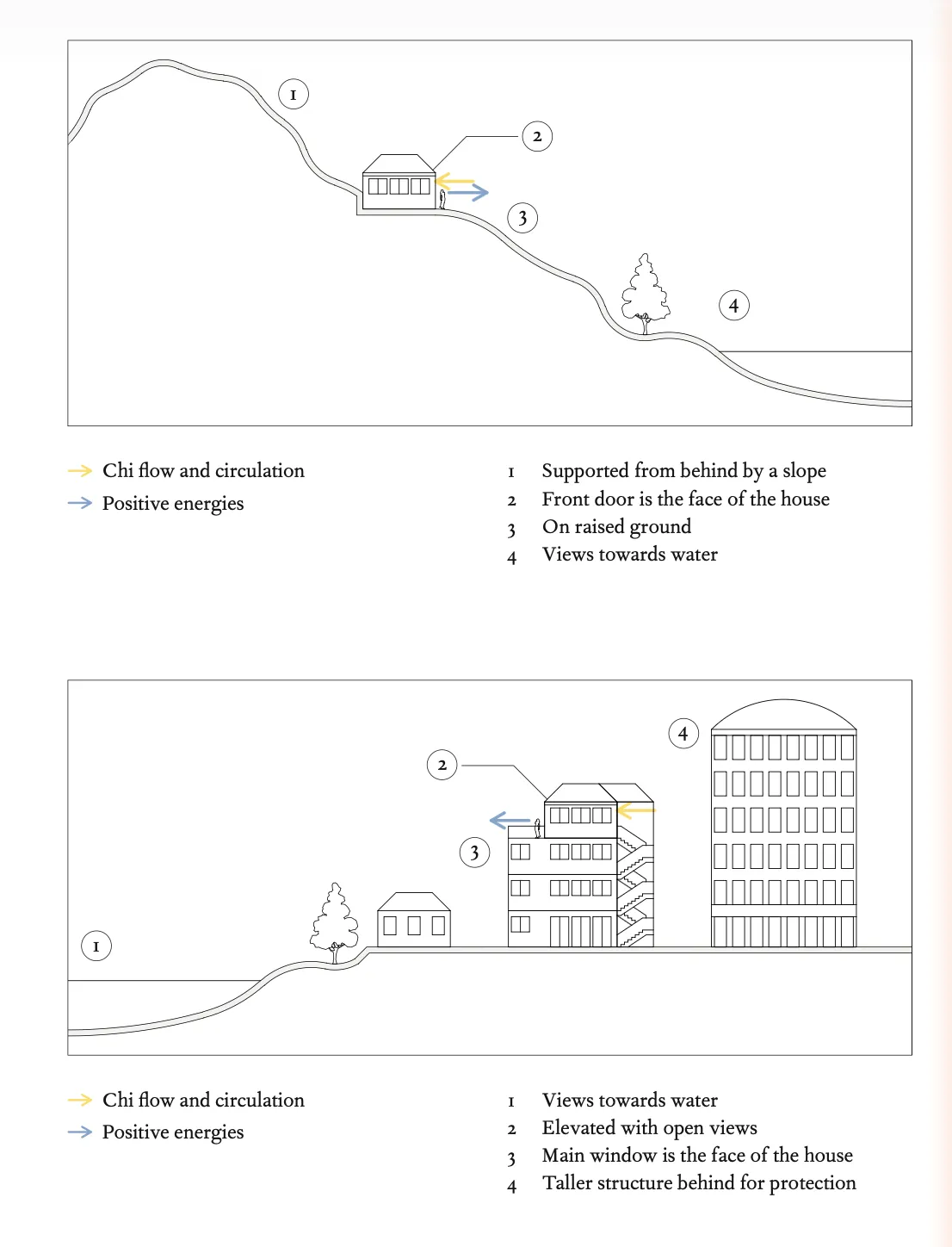
4.1 Choosing a home
- List personal and practical requirements and order according to priority.
- Ensure structural soundness, especially leaks. Homes are shelter from rain and water.
- Select a neighbourhood for access to green spaces, clear air and running water, and community.
- Choose for here and now rather than anticipating long-tern future. Be sensible.
- Direction is determined not only by front door but by feel of the strongest feature like the largest windows.
4.2 Entrance
A beautiful entrance is key to creating a good feeling when you come home every day, and will bring good fortune and energy. For visitors, it is the first experience of your home, and you want it to make a good impression. The main door is the door you use most to enter your home – and that might be at the front or the back of the house.
- Celebrate the entrance! Surround with light and energy to make welcoming. Ensure space upon entry.
- Soften approach. Avoid intimidating, straight long path to entrance. Create meander and soften with features like shrubs.
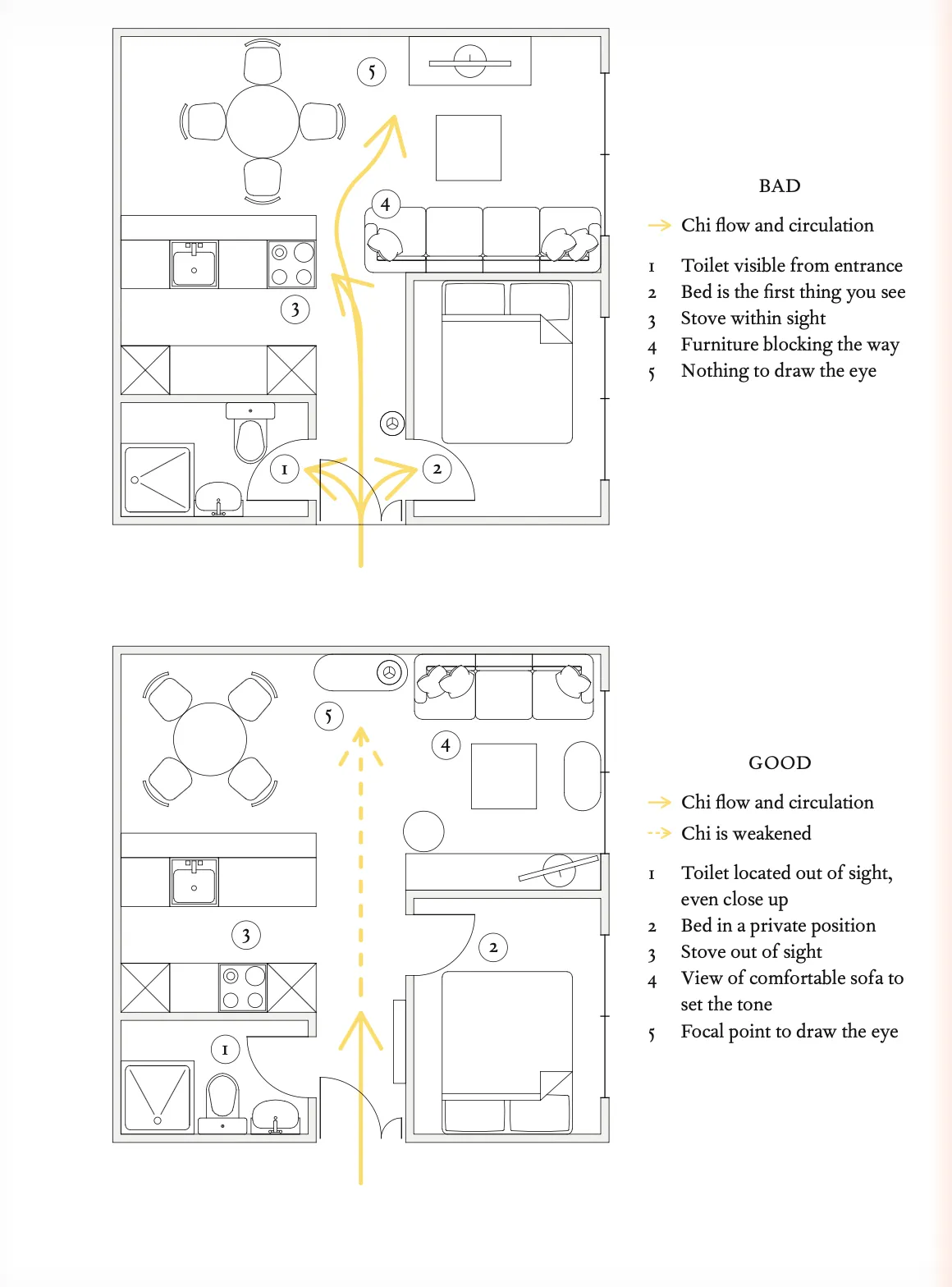
- Internal entrance space should be public not private, otherwise use features to lead eyes beyond private areas like screens, rugs, colours and focal pieces beyond.
- Apartments entrances with facing doors can be confrontational. Avoid awkward feeling by cooperating with decor.
- Main door colour depends upon direction. For North, use Water black to blend in. For South, use Fire bright colours. The main door creates impression of what to anticipate indoors.
- Entry mat must not display regarded symbols. Trust your instincts for designs and impressions intended.
- Door should open inwards to encourage inflow of Chi.
- As the mouth of the home, the door should be proportionate to your home’s scale, while at the same time being more prominent than any other door in the house or apartment. A door that’s too small can mean that less fortune will enter your home. A door that’s too big won’t be able to hold your fortune, or could mean that you’re not modest.
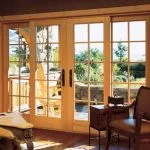
- The main door should be made of solid wood. Glass represent fragility. The door should be strong and sound to symbolise security. French doors are not considered as doors.
French doors
- Treat hallway like a full room. It creates first impression of the interior and sets the tone. Use it to soften any strong Chi from outside. Keep shoes tidy.
- Avoid mirrors directly opposite the main door because it will deflect Chi.
- Keep entry space bright and well lit to celebrate returning home.
- Add Yang broad-leaf plants to celebrate thriving life.
- Sacred artefacts in the entry space act as reminders and inspiration for guidance and personal worth and values.
- Keep hallway open and spacious without obstacles to allow smooth entry and exit.
- Avoid sharp corners or beams in entry area, otherwise soften with same colours as wall, or with plants or lights.
- Hide brooms, mops and bins from entry area.
- Brighten long, narrow, dark entrances with mirrors on side walls, or vibrant artworks. If too tight, use pendant lights or add focal point in distance such as artwork or lamp.
- If there is no internal entry space, improvise with furniture arrangement, screens or rugs.
- Mitigate strong Chi of entry stairway by screen or turning away of last two steps, otherwise use pendant light to draw the eye upwards.
4.3 Living room
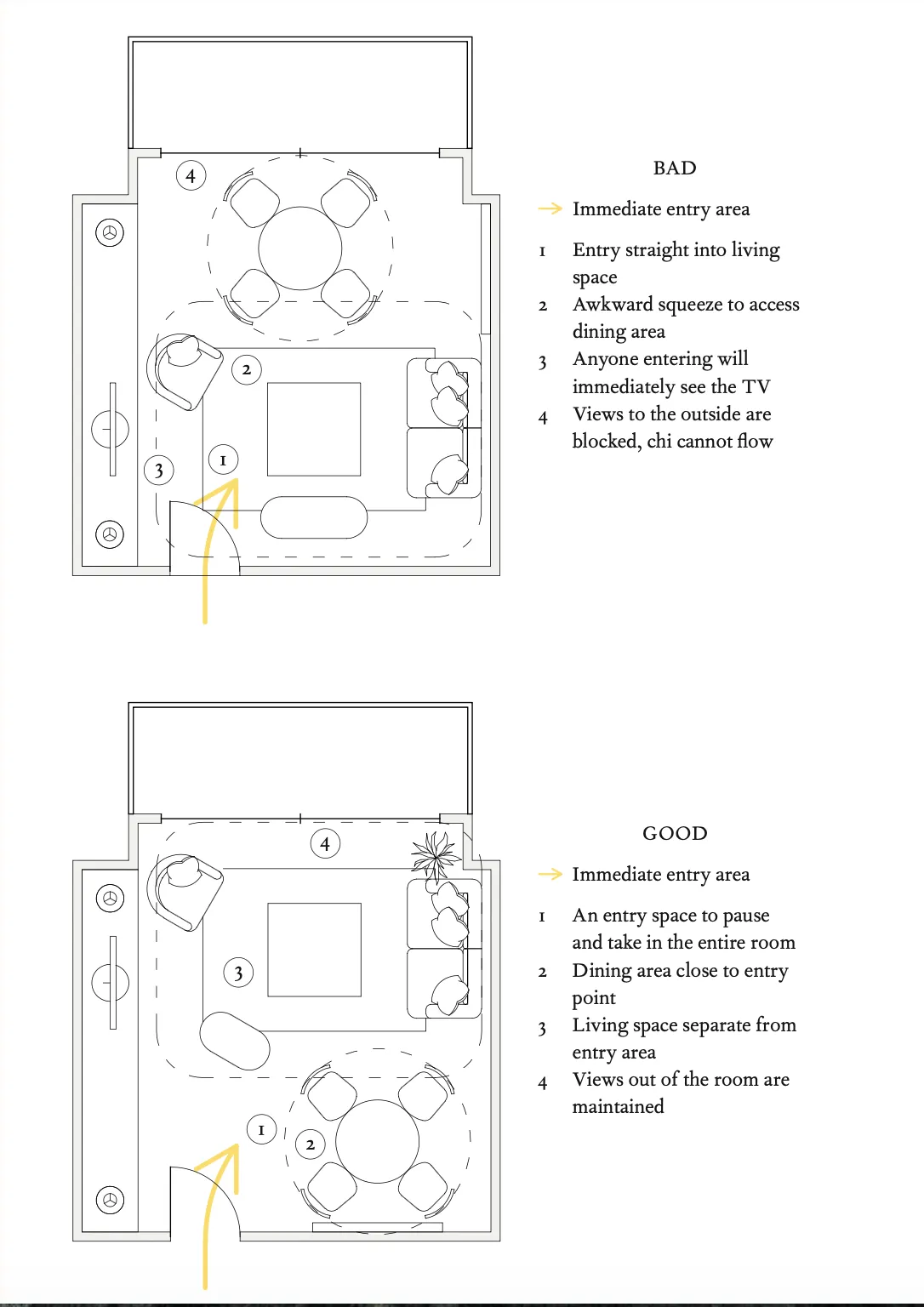
The living room is the most important room in the house. It’s the anchor, the place where family members gather. It’s usually the largest room, and the first place you bring visitors, making it the room with the most life and positive Chi.
- The Living Room should be in the middle of the home in sight of all the other rooms.
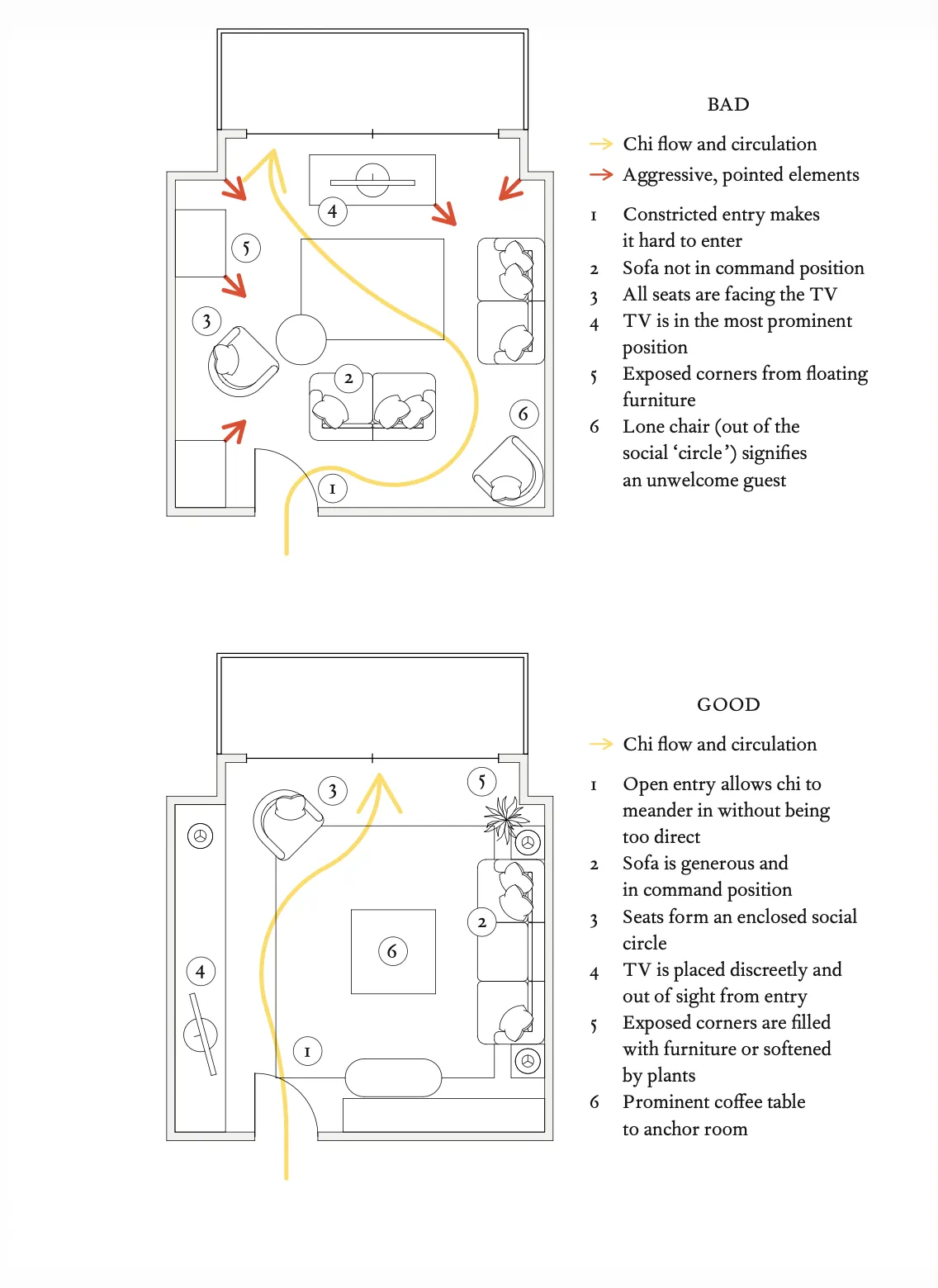
- The Living Room is flexible and can have many functions. It should feel inviting. Seating furniture should face each other to encourage communal interaction. Don’t make the TV a focal point. Make people the focal point.
- The Sofa takes Command Position guided by Five Animals. Accompany one main Sofa with armchairs, a bench or a statement stool.
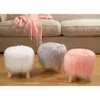
Example of statement stools
- Place a coffee table between facing Seating furniture to mitigate confrontational feeling.
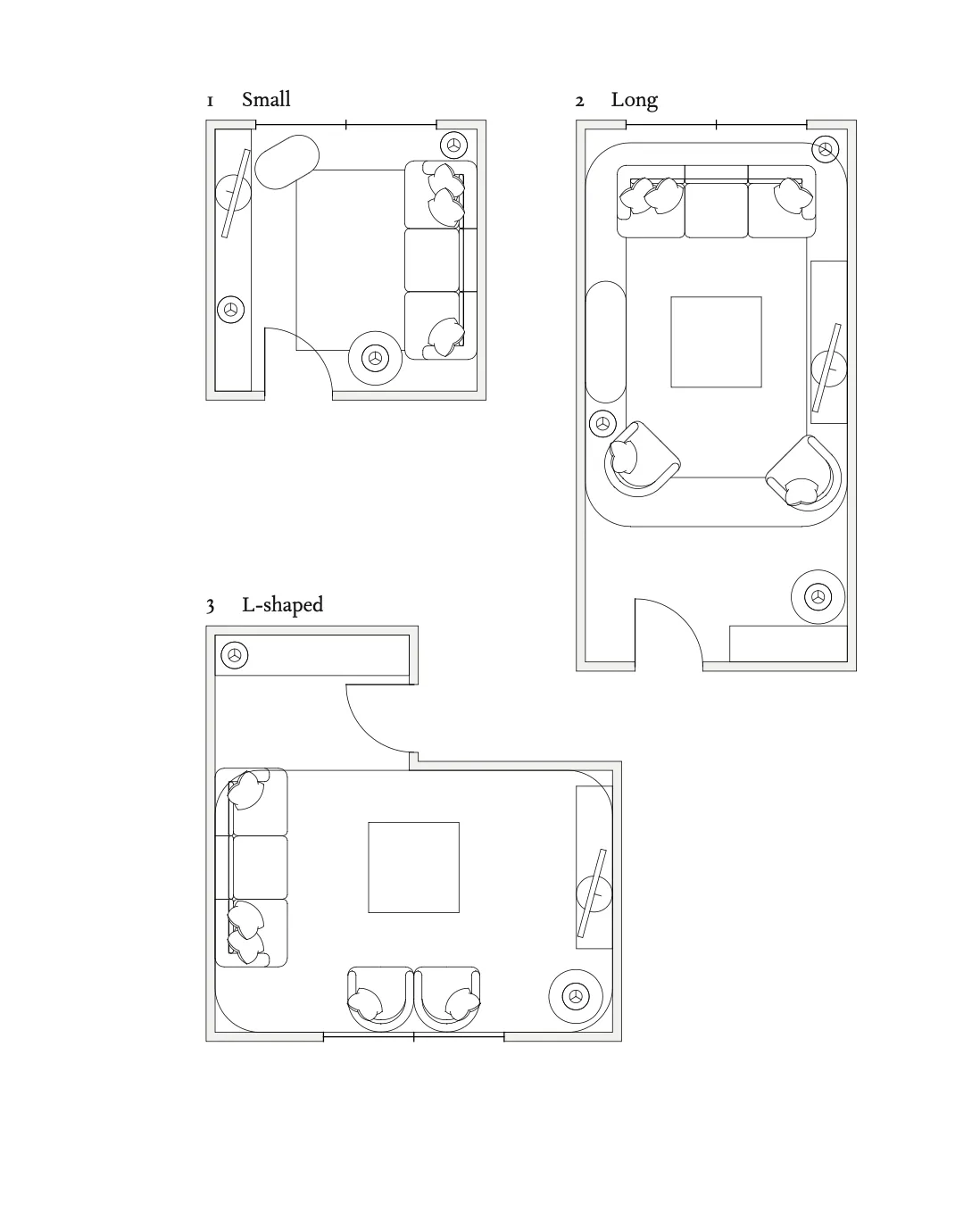
- An L-shaped sofa forms an incomplete social circle. Place an armchair or two diagonally from the corner of it.
- If you can’t place the sofa against a wall and it needs to float in the room, have a low console table behind it to offer rear protection, or opt for a sofa with a thick back rest or one that is firmly grounded on the floor.
- If your living room has sloped ceilings, try to avoid placing the sofa under the low end. If this is where the command position is, place lights on either side to ‘push’ the ceiling upwards.
- Guest seating need not be in the Command Position.
- A coffee table is placed in the centre of a room to anchor the space and unify the separate seats, without it the room is unmoored. As a significant piece of furniture, your coffee table should be decorated with something beautiful and lively to suggest surplus and prosperity.
- Side tables expand the scale of small sofas, making them feel wider and more generous particularly if there is no coffee tables.
- Deprioritise the TV in the room.
- A good rule is to place mirrors where you would otherwise like to have windows.
- Create depth in your living room using many different light sources.
- A small room is cosy: have fewer but larger pieces, like one double sofa instead of two armchairs. Use large objects that don’t take up floor space. Think big lighting or a statement artwork, as these add scale. Similarly, try floor-to-ceiling curtains. Ensure that seating and walking spaces are generous – don’t block access and don’t clutter seats. Rugs bring scale without compromising on space, but make sure they’re large enough to go under half of all furniture in the room.
4.4 Dining room
While the living room might be the most important room in the house, the dining room or dining area comes a close second, and should never be an afterthought. It is the heart of the home, as it brings friends and family together.
- Place Dining Room at home’s centre, not too close to the entrance, nor in view of the main door, where it will get too much Chi. Otherwise, centralise with mirrors to expand space to the off-centre side, or decorate room symmetrically with pendant or light.
- The Dining Room will be visible before the private areas of the house, and on a level floor than the bedrooms – but not in the basement.
- Prioritise a Dining Room near kitchen and ensure clear and accessible pathway.
Decor
- Dining Room is heart of the home represented by Earth. Keep features earthly and neutral. Tone down colours for this area.
- Utilise mirrors or artwork to reflect food, contentment and energy.
- Avoid a sense of emptiness and showcase abundance with fruits, flowers or plants.
- Avoid clocks which create feelings of haste.
Dinner Table
- Centre dinner table and ensure comfort and space for seaters with entrance view without obstruction.
- Dinner table, unlike Sofa or Bed, has no Command Position.
- Circular tables avoid sharp corners and hierarchy. Oval next best then Earth Square. For Rectangle, be mindful of Command Position.
- Avoid irregular shapes or joining tables.
- Avoid glass tables. It can disconcerting to see legs while eating otherwise use table cloths. Wood, stone and clay are best.
Chairs
- Worse seat is one with back to entrance for host. Offer best seats to seniors.
- Chairs should look the same and look comforting and welcoming.
- Use chairs that look solid and stable.
- Low-back chairs look more relaxed.
- Use even numbers of chairs.
- Keep spare chairs away from the room, left on the side of the dining room or around the table, they signify unwelcome guests.
- Ensure side furniture does not loom over Dinner Table.
- Arms create intervals between seats.
Small rooms
- Use smaller table but larger chairs to make room feel more generous and comfortable.
- For more seating, use armless chairs with low backs to expand space. Beautify table to compensate.
- Mirrors expand rooms and can off-set a table against a wall.
- Use furniture and plants to soften any irregular room shapes.
- Use nooks and crannies for functions, e.g. drinks area.
- Dinner Tables in transitory spaces should use consoles around the table to anchor the space. Ensure walkways around table. Balance table placed off-centre in room with pendant.
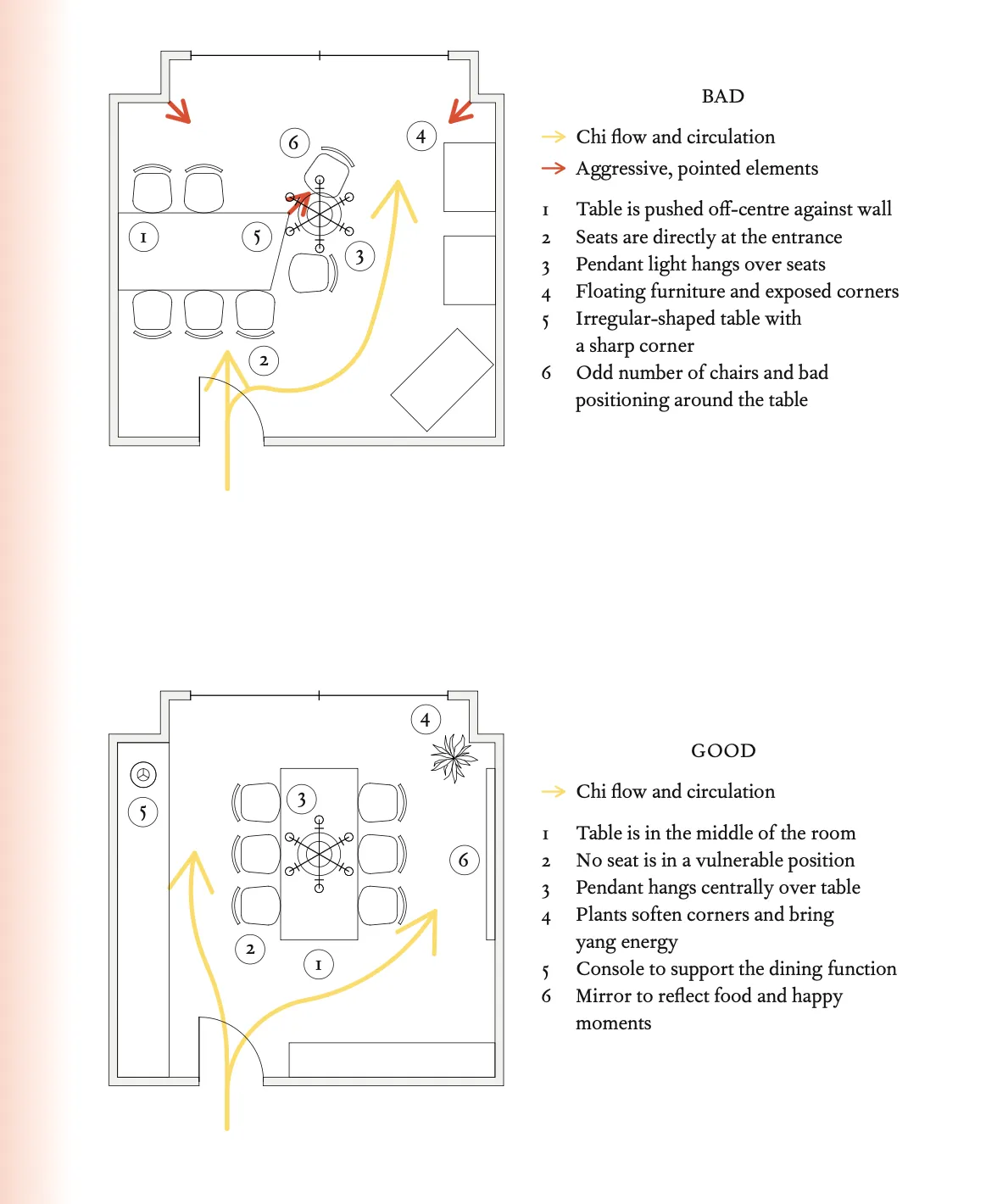
Dinner Table should feel unified and whole.
4.5 Kitchen
Feng shui traditionally viewed the kitchen as a service room that wasn’t a part of the home. It was considered to have a disproportionate influence from the element of fire. Of course, over time this has changed, and feng shui itself now needs to catch up – but that’s okay! Modern kitchens have better insulation, and they perform better than they did in the past, reducing the impact of fire. More importantly, kitchens often now take on the role of social spaces, where the family may gather to cook together and share happy times.
Location
- Locate in rear. Fire burns away good Chi entering home.
- Avoid Water rooms nearby. Close bathroom door.
- Avoid mirrors - they reflect aggressive Chi - and Water items.
Items
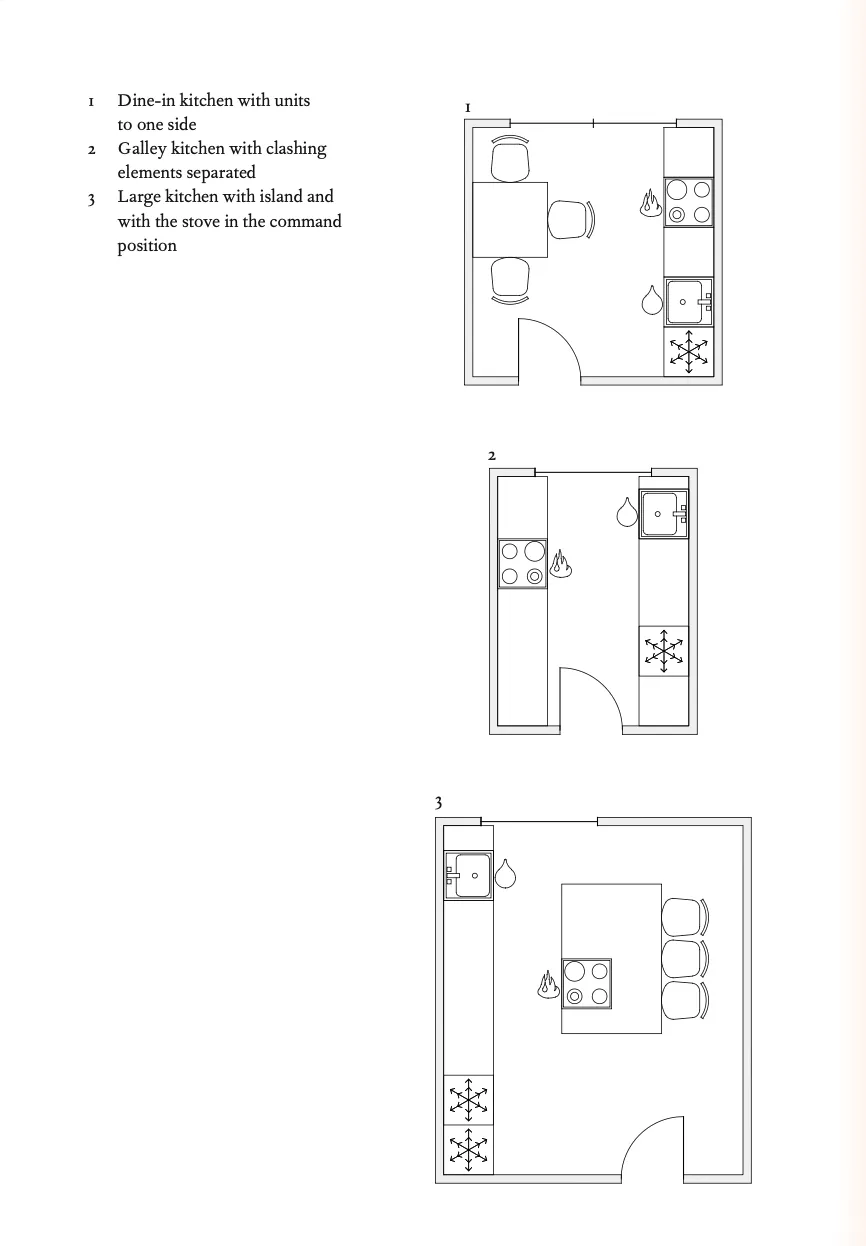
- Stove is in Command Position.
- Balance Water colours with Earth colours.
- Knives signify aggression. Keep out of sight.
- Sink is second most important element of Kitchen. Avoid placing Stove and Sink next to each other, otherwise use Wood, such as plants, to mediate between Fire and Water.
- Ensure Water Fridge is separate or insulated from Stove.
- The Fridge is not something to celebrate. Blend in.
=Keep tidy and uncluttered.==
4.6 Office
If you apply properly the principles of feng shui to your work area, your efforts will literally pay off! The command position really matters in an office space, because this is a room where you concentrate and make a living and you need the best environment to perform to the best of your ability.
Location, feeling and plan
- Make distinct from other home functions.
- Make colours match the aspirations of your business. If you want growth, choose greens and light blues; if you want wealth, use rich tones such as gold; and if you want stability, use earthy, neutral tones. If your business is fluid and versatile, black or dark blues are appropriate. If it is precise and pristine, choose white.
- Art and graphics can be powerful motifs and should symbolise your work and positive growth. Avoid hanging portraits in your office, as faces can intimidate – unless, of course, they inspire you.
- Opt for even, bright lighting in your office.
- Keep the space neat and tidy at all times, unless you have a very specific system. Even then, always categorise your work and documents sensibly so you won’t forget where you’ve put things, should you need them again.
- Use plants in Yang Office.
Desk
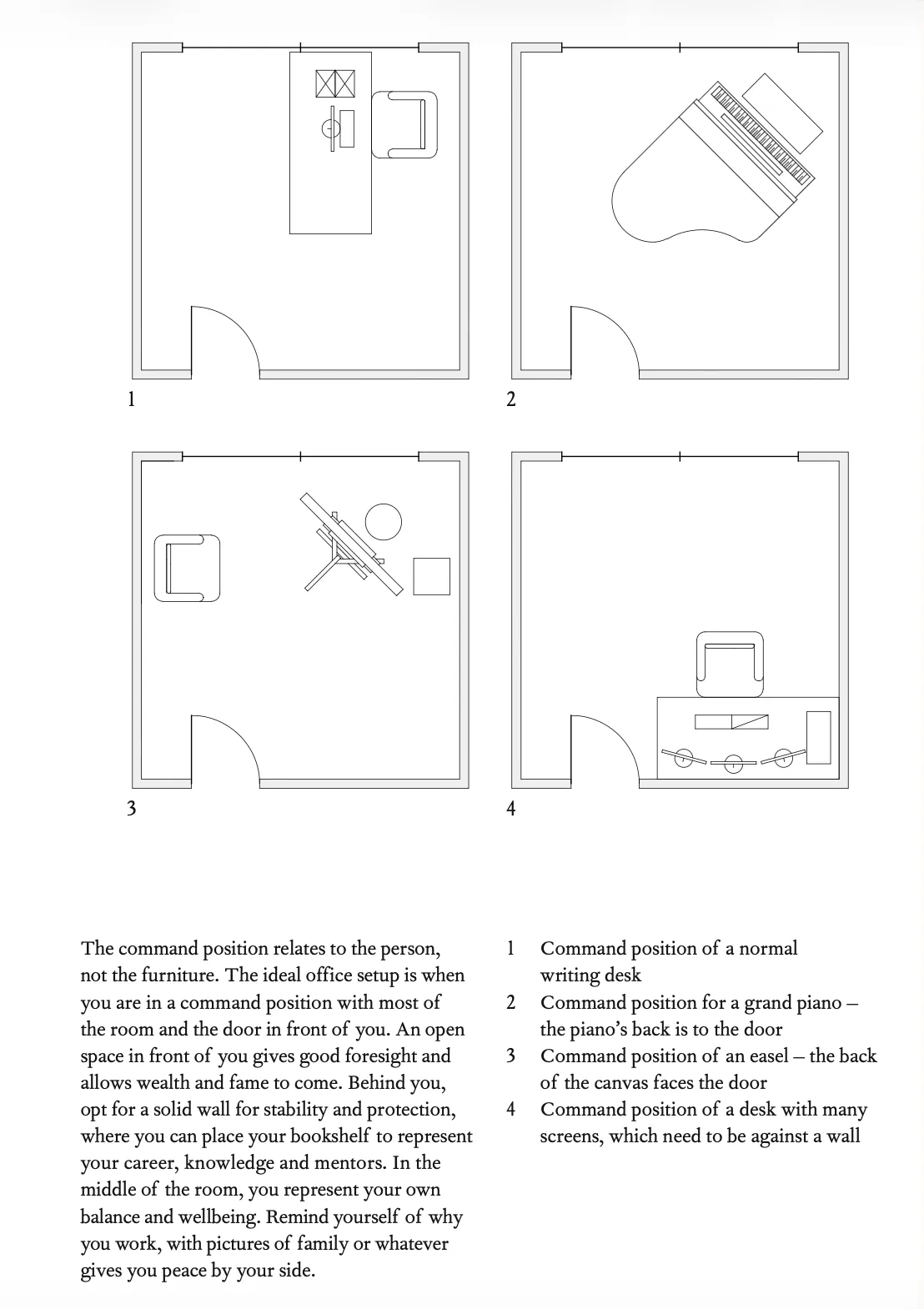
- Desk, or main Work Furniture e.g. piano or sewing machine, assumes Command Position.
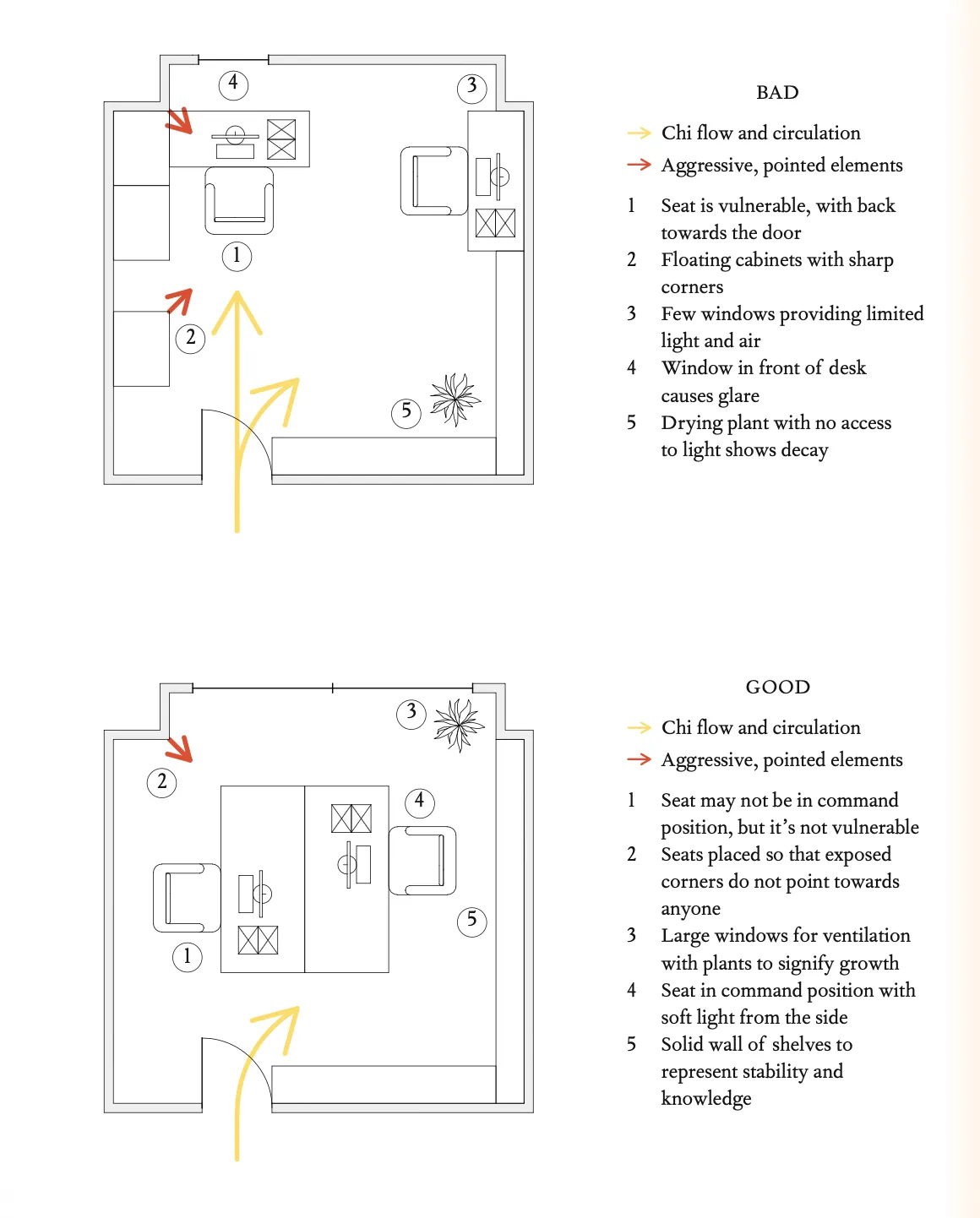
- If you can’t achieve the command position, it’s fine to have your side facing the door, just not your back.
- Chi comes in through doors, so avoid sitting too close to the one that opens into your office.
- Screens are windows so can be in front of walls.
- Rectangular desks are for hard negotiating. Curved desks are for creativity. Reflective surfaces bring too much energy. Light- or natural-coloured desks are best.
Bookshelves and storage
- Avoid open shelves. They give off aggressive Chi.
- Prioritise accessibility over location.
- Keep books upright. Side laid looks cluttered.
- As a rule of thumb, keep reference materials behind you, to offer you knowledge and support, and keep the area in front of you clear, so as to not clutter your views and so your thoughts.
Seating
- If there is space, you may have a sofa bed or daybed for relaxing during the working day or for accommodating guests. Reserve the best command position for your desk, but ensure the sleeping or sitting furniture is not in a compromised position, such as pointing towards the door.
Challenging room shapes
- For back to door, keep door closed during work, or use front mirror, or high back chair.
- For desk facing wall, use deeper desk to distance and add life with artwork.
- On balance, it is better to face the wall than have your back to the door.
- For multifunctional space, seclude workspace with furnishing.
- For windowless office, use for short periods at a time.
- For shared space, if workers equal, compromise command position, otherwise size by hierarchy. For two, ensure looking at work not possible by facing desks.
4.7 Bedroom
The Bedroom is a place of rest, a sanctuary from the outside world. It is your place to recharge and forget about the tasks of everyday life. The goal is to create a neutral, calming Bedroom space, where you do not think, and your mind lets go and relaxes.
Location
- Locate bedroom far from Main Entrance, Bathroom and Kitchen, past public rooms. For Bedroom close to Main Entrance, keep Bedroom door shut and use colour same as outside wall for discretion.
Feeling and Plan
- Bed assumes Command Position. Avoid desk, exercise area and TV in Bedroom, otherwise seclude Bed exclusively for rest.
- Bedroom is Earth. Use horizontal lines with neutral and natural tones.
- Bedroom should be square or rectangular, but not long, and without sharp corners that point towards the Bed. For large rooms, create zones using rugs to anchor.
- As a rule of thumb, if a plant couldn’t survive, the room is not suitable to sleep in.
- Use inert and analogue over digital and electrical.
- If any Yang items give you a sense of calm or belonging, or if you regard your plants as your friends to share the space, they are okay.
Bed
- Choose a bed with a bedhead that is solid or padded, and the bigger and wider, the better. Avoid bare frames. *Choose a stable, not flimsy frame. Avoid water beds at all costs.
- Four-poster beds can look severe. Low beds are more calm.
- Ensure the bed is raised off the floor to allow air to circulate around it.
- Storage beds are fine, but do not over-stuff the storage under the bed, as moisture will build up.
- Choose light, calm colours for your bedding. If you prefer dark, don’t go for black.
- Make your bed when you get up to avoid any build-up of stale Chi and prepare you for a peaceful return at the end of the day.
- Place bed against wall but not against window unless with strong bedhead, heavy curtain, or windowsill higher than bedhead.
- Have Bird openness at foot with broad, commanding view of Bedroom and Door, otherwise seclude out of view from door.
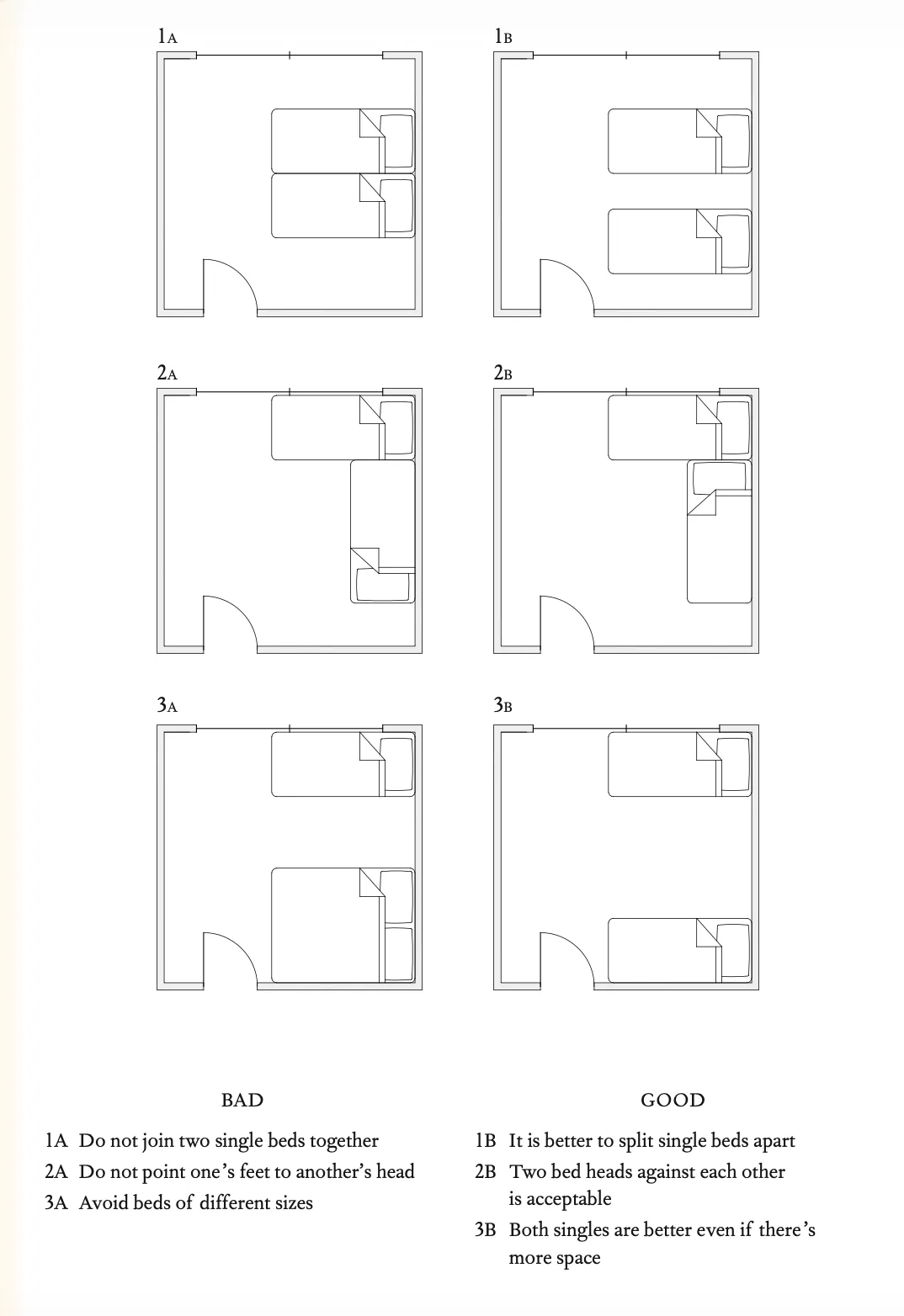
- Ensure entry from both side if shared with bedside cabinets and lamps of equal visual weight.
A classic rule of feng shui is: do not point your feet directly towards the main door to a room. This would direct chi straight up to you, but it also recalls the position of a coffin, or even of a breech birth, which is highly inauspicious.
- If your bed is directed towards the door, do not place it in line with the door or block view.
- Avoid feet towards window, as this generates too much Movement Chi, unless window small or view calming.
- Mirrors behave like Doors. Place so reflection can’t be seen from Bed.
- Avoid sharp and heavy objects that project oppressive Chi.
- For sloped ceilings, place head at higher end, otherwise have strong bedhead and lights to lift area.
- Avoid furnishings above head except light tapestry or mural.
- Fitted wardrobes allow more storage and look minimal.
- Larger single unit is better than multiple smaller units.
- For small bedrooms, start with biggest pieces and place furthest from room corners.
4.8 Bathroom
In China, bathrooms were traditionally located outside the main building of a home – they were undesirable places intended solely for the elimination of waste. This is why feng shui rarely refers to the bathroom in its principles. However, the improved smell and moisture control of the modern bathroom makes it a more acceptable room in feng shui terms. Furthermore, our lifestyles have changed. Far from being a place merely of waste disposal, a bathroom is now often regarded as a place to rejuvenate and achieve a sense of peace. As you take on the advice of this chapter, adapt its suggestions according to your own needs, wants and feelings for your bathroom space.
Location, feeling and plan
- The WC is akin to the bottom of the house and should be furtherest from other rooms. So long as you do not see it, the effects of its presence are mitigated.
- Avoid mirror reflecting WC.
- Natural light, or even direct sunlight, is best, otherwise use lighter colours and bright lights.
- Plants bring upward-growing Chi.
- Ensure ventilation natural or mechanical.
Modern bathrooms can be places of calm, especially considered in the light of the ritual of bathing. Design the bathroom to reflect this ambiance. As the bathroom relates to the water element, avoid decorating yours in colours that destroy water, specifically fire colours, such as red. Features that evoke the elements of earth and wood balance the water nicely.
WC
- WC assumes Command Position away from door but with it in sight.
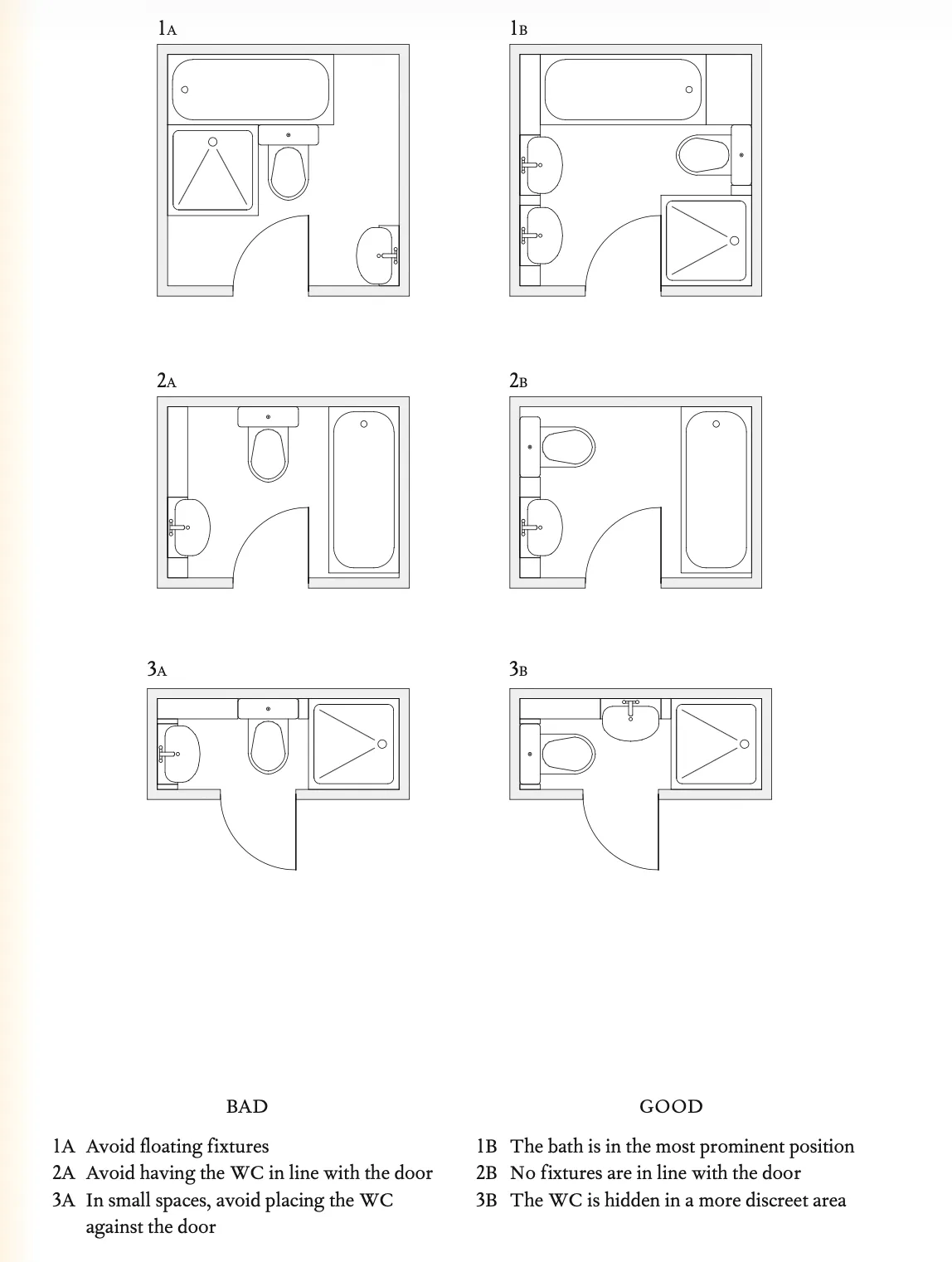
Bathtub and shower
- Bath and Shower are second in command.
- Sink and Vanity Cabinet are third in command. Avoid back to door. Place at right-angles to door.
- For windowless bathrooms, avoid top-down lighting as this is harsh and not very flattering.
4.8 Shared spaces
The general rule is that any shared space should be sectioned into its different uses...Having a designated place for the various types of activity aligns with our natural tendency to make mental connections to place. It’s the same principle that tells us it’s better to place a cat’s food bowl and water bowl in separate places, because hunting and finding water are different feline activities. In feng shui, the goal is always to match our spaces to our natural tendencies as much as possible.
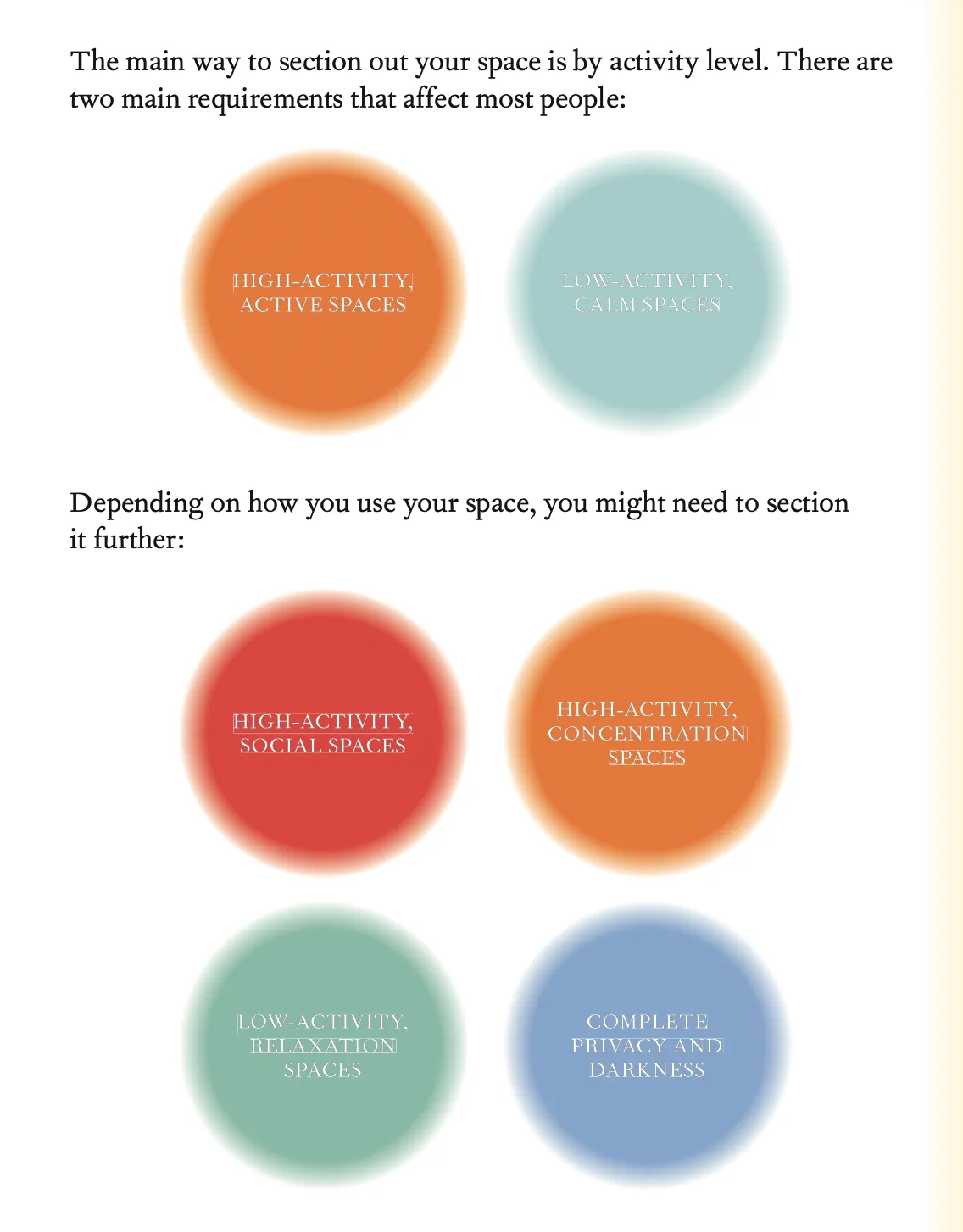
- It’s important to consider activity level rather than room type, because, for example, a living space for one person may be calm and private (so a good place to consider situating a bed next to), while for another person it might be a social space.
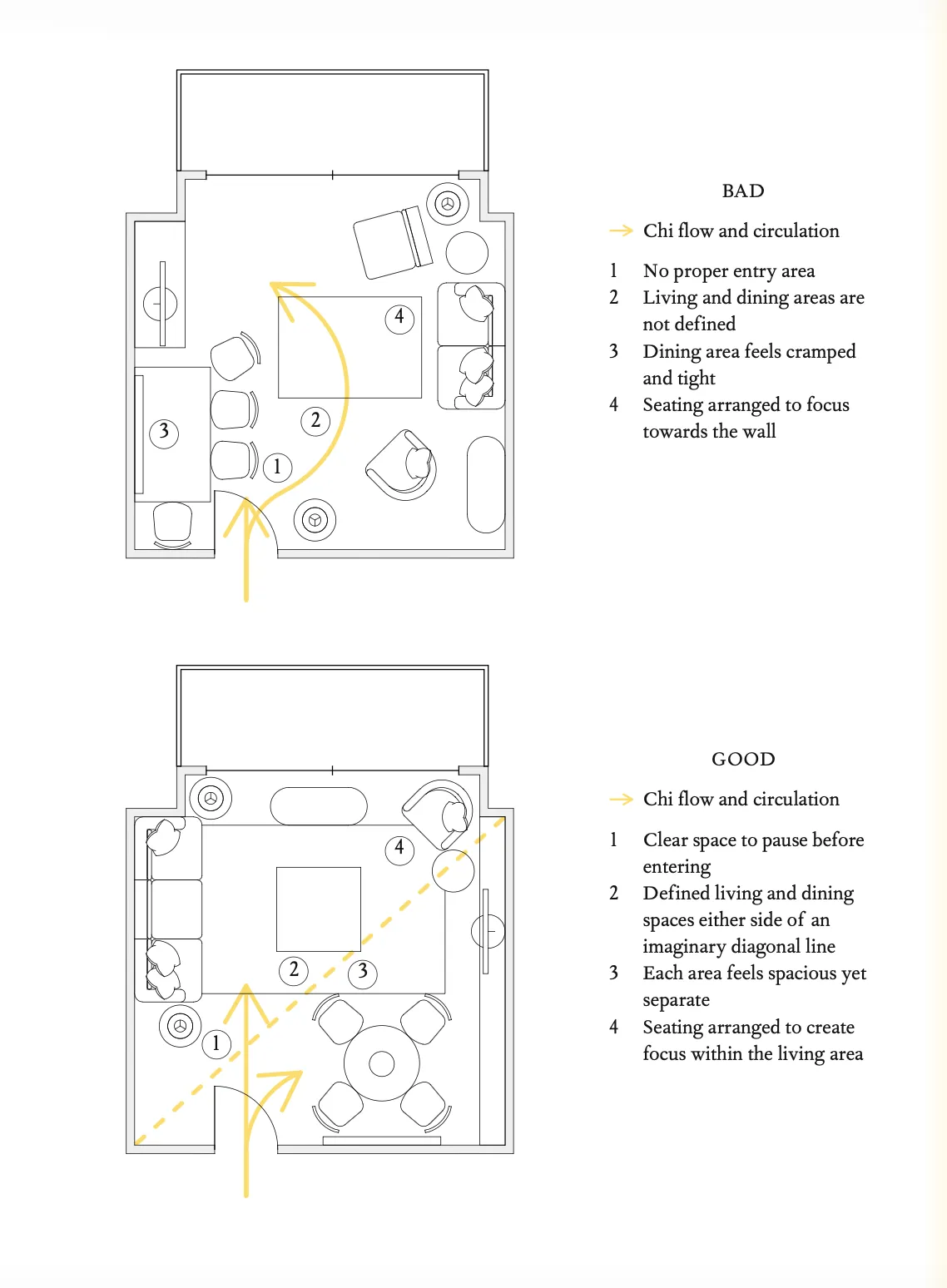
- Living and Dining areas share the same energy and activity level. Do not let the Dinner Table encroach into the Living Space.
5. Styling
- Make the one chance good first impression for yourself first.
- The main design principle is that the space must look good from one angle - the approach to it to establish that good first impression.
- Key item in the room should anchor your view, usually the Command Position piece. The key item determines the room function.
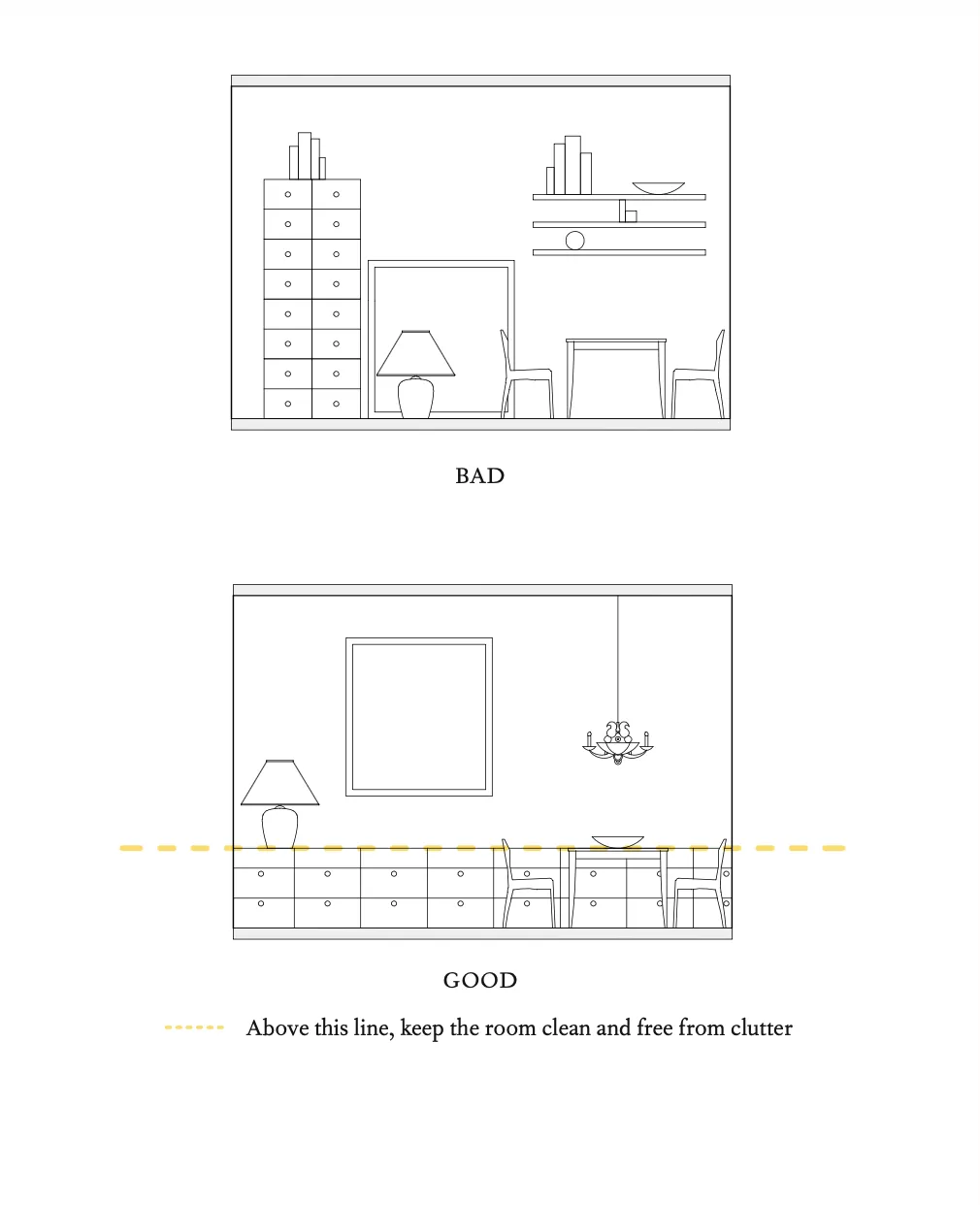
- Compose view to align with intended feeling of space: living room - grandeur, welcoming, comforting; bedroom - instant calm, and so on.
- Divide room into top two-third and bottom third sections. The lower section is for furniture and utilitarian matters. Top section should be empty, reserved only for decorative items, such as pictures, lamps, plants or ornaments.
5.1 Clutter and storage
- Sort items into categories and sub-categories. No ‘miscellaneous’.
- Use an object about which you are passionate and that feeling to judge whether other items are worth keeping.
5.2 Artificial lighting
- The goal is not to light up a room as evenly or brightly as possible, but to thoughtfully choreograph the balance of yin and yang in a space.
- Light bulbs have two qualities that affects theirs feel: colour of the temperature and the diffusion of the emitted light.
- Colour temperature is the yellowness of a light and is determined by Kelvins,
which is a number ranging from about 1500 to 6500.
Whichever yellowness you choose, be sure that all the light bulbs
in a room are the same.
- 2700K These aim to match the colour of natural tungsten filaments, which are actually 3000K. However, in LED bulbs, the colours are more red and less natural, so it’s better to choose something around 2700K–2900K to match (each brand will vary). Don’t go warmer than 2500K, or the light will look unnaturally orange.
- 3500K Think fluorescent studio lamps or office lighting.
- 4000K and above When the colour temperature mimics daylight, it becomes unnatural, and will confuse your senses. Use bulbs of 4000K or above only if your work requires it, or if you need to replace the energy of the sun during long winter months.
- For study rooms where light is important, consider using reflected light. An easy way to do this is to have a strong uplighter, and shine it against a white ceiling. This will give the room a washed-out, but soft glow, which will not cast any shadows.
- Diffusion is determined by light-bulb coating.
| Bulb Type | Visual Effect | Symbolic Quality | Shadow & Attention |
|---|---|---|---|
| Frosted (opaque/opal) sphere | Soft, diffused light | Yin – gentle, receding | Soft shadows; blends into background |
| Clear glass sphere | Dazzling, piercing light | Yang– bold, commanding | Hard shadows; draws strong focus |
Generally, it’s better to use multiple light sources to light up a single space, because in the natural environment, internal spaces receive light from many different directions, from openings in the walls, flames, or reflections from the ground. If we can mimic these natural phenomena, our eyes feel more at ease. This is why for windowless rooms, it’s better to have soft light washed against walls rather than a piercing central light source.
Floor and Table Lamps
The staples of any lighting scheme, floor and table lamps represent the simplest forms of artificial lighting, harking back to candles and oil lamps, where light is from a lower, side source. Floor lights are useful to add height to low ceilings, or to bring down the scale of higher ceilings. Table lamps act as sculptural pieces to anchor consoles or side tables. The most common type of table or floor lamp is the conical lampshade, which references the Fire element, an apt symbol for a light. These lamps make a room feel calm.
Ideally, you should place diffused floor and table lamps in corners, particularly ones where you want to increase the yang energy, remembering that the balance of Yin is important in any space.
I would recommend lighting three out of four corners of a room according to the activity level in the room, so that there are designated corners of Yin and to create balance. You can also place lights at the end of corridors or long rooms to bring those spaces forward. Another tip is to locate lights in front of windows, because this is a natural place for a source of light.
Placed at the low ends of sloped ceilings or pitched roofs, table or floor lamps have the effect of ‘lifting’ oppressive, low ceilings. If you have a bed inside a niche, placing lights inside would also elevate the space. If your room is irregular, you can use floor or table lamps to light up darker corners to square off the room.
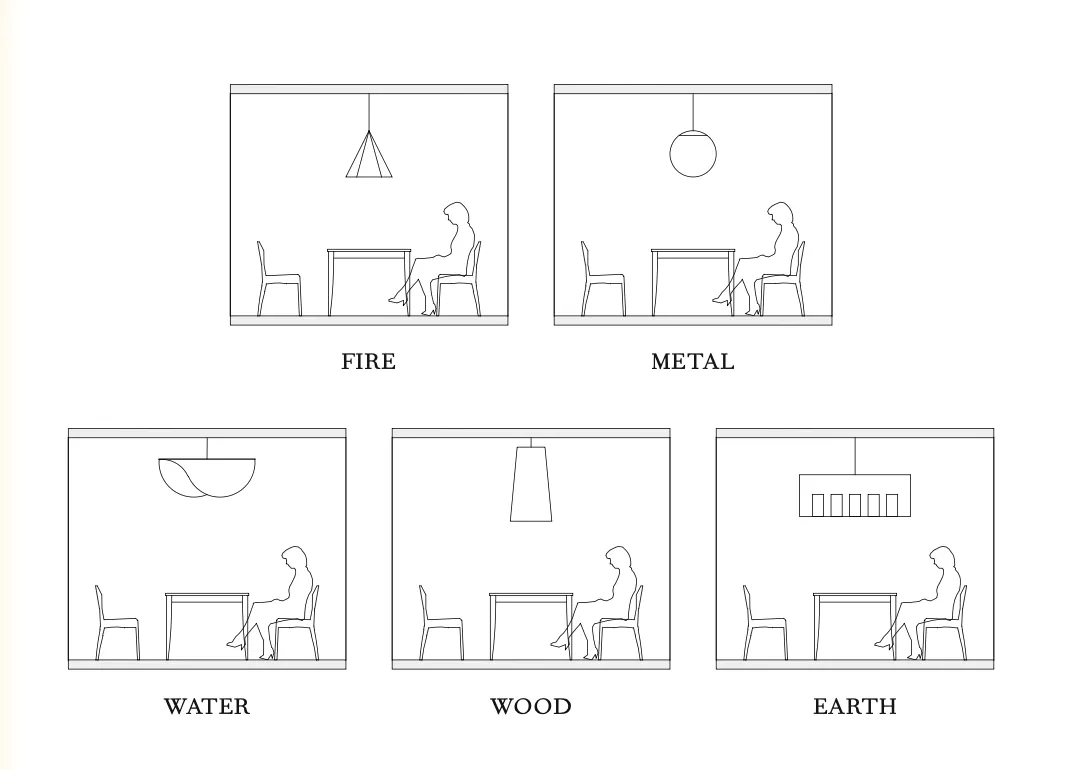
Round shades are best, as they represent fullness and perfection; they reference metal and even symbolise heaven. Triangular shapes echo fire, which is linked to light, and form a potent symbol in the middle of the room. Do not hang square pendants or shades as they represent earth, which should be on the ground. This also goes for vertical rectangles or wavy shapes, as these are for water and wood, which should also be grounded. If choosing a pendant light in a fluid shape, make sure the fire and sparkle of the light overcomes the feeling of water.
Desk or other Task Lights
Libraries and workshops, where you need to direct light to be able to see closely for work or a particular activity, are the most common settings for ‘task’ lights. Place them only on work tables, side tables where you have a place to sit and read, or as floor lamps next to armchairs. Avoid using task lighting in your bedroom – a diffused table lamp is more suitable for the space.
Uplighters
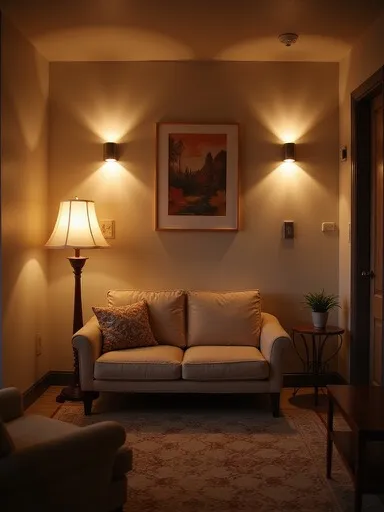
Giving the visual effect of fire, uplighters are best in rooms with no windows or very low ceilings. They lead the eye downwards, and wash light against the walls mimicking the way light reflects off water in windowless caves and grottoes. Uplighters are also a good way to highlight architectural features in grander spaces.
Track and spotlights
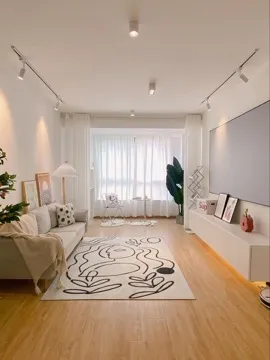
These do not have much of a presence, but offer directable light, which helps you to control the light and shadow, or yin and yang, of a space. When you have directable lights, focus them on objects around the room, such as artwork on the wall, or tables. Do not point them to random spots on the floor, or towards seating.
Recessed lighting
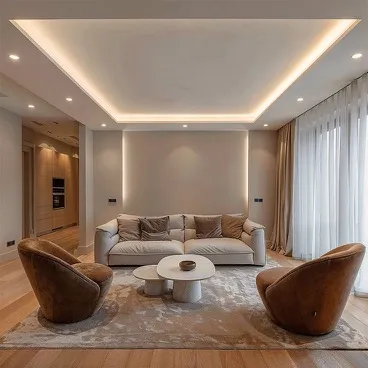
This is a clean way to bring light into a room, although you need to plan carefully the position of each light – people often make a light grid without thinking. When designing recessed lights, position them over where you want to create depth and shadow. Position lights over table tops and avoid putting them over seating areas. Leave shadows in unusable areas, such as passageways or corridors.
Mounted ceiling lights
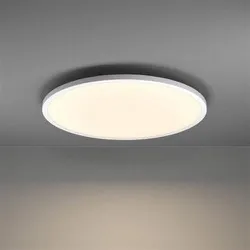
These often elaborate designs are more like compressed chandeliers, and can look beautiful in the right settings. Try to avoid flush-mounted ceiling fixtures as they tend to produce flat and dull results. For surface-mounted lights, avoid squares, as they recall earth. The only suitable shape for surface-mounted ceiling lights is the circle, which recalls heaven.
Wall-mounted lights
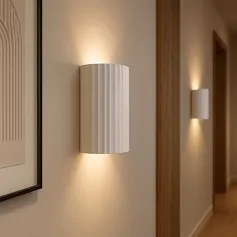
Choose shapes that reflect light on to the wall. Make the wall lights as discreet as possible, unless they are statement wall pieces and are meant to behave like art.
5.3 Colours

White
Don’t assume that white should be the default neutral colour. To choose to paint a room white is a very conscious decision, because white is not a base colour. It represents the metal element and sits at the end of the colour spectrum, leaving very little room for interpretation. If you’re unsure about white, a far more neutral and versatile tone is a mid-grey.
- Determine colour according to temperature of room. Even seemingly monochromatic tones have warm and cool ranges.
- The less saturated a colour, the calmer and more muted it feels. If you feel unsure about what colour to paint your room, opt for shades with lower saturation. Instead of yellow, go for tan or sand; and instead of bright red, go for terracotta. Note that the saturation of a colour can change the feng shui element it represents. A grey-blue would represent water, while a very saturated blue is closer to wood.
| Element | Symbolism | Recommended Colours & Tone | Usage Tips |
|---|---|---|---|
| Fire 🔥 |
Energy, passion | Warm‑hot reds, deep oranges; keep saturation high but use sparingly. For whole‑wall applications, desaturate toward terracotta/earth tones. | Small, powerful doses. Too much can disrupt sleep. |
| Earth 🌍 |
Balance, calm, inner peace | Neutral, subdued yellows and light browns; favor low‑saturation, warm greys over bright yellows for large areas. | Great for large walls. Yellow can boost appetite—use mindfully. |
| Metal ⚙️ |
Precision, transformation, density | Clean whites, light blues, light greys. Darker greys shift toward “water.” White works well as an accent on lighter grey backdrops. | Ideal for study spaces. Whole‑room white creates a strong, slightly tense atmosphere. |
| Water 💧 |
Fluidity, depth, downward search | Dark, mysterious tones: deep blues, dark greys, blacks. Light blues become “wood.” Avoid pure black; use very dark blue or brown instead. | Use as accents or framing. Blue suppresses appetite—avoid in dining rooms. |
| Wood 🌳 |
Growth, vitality, life | Bright, saturated cool greens (not brown); lighter blues can work. When paired with brown, include green undertones. Subtle green‑grey works for walls. | Highlight with plants/natural materials. |
5.4 Art and sculpture
Wall Objects
Wallpaper and a feature colour are a type of art in its own right.
Types of wall object
The main significance of home art is for their personal value rather than being the right type. However, there is a very wrong type. This is any object used simply for the sake of filling a space, especially mass produced works.
- Choose only items that have true meaning for you.
- Work out where to display the art piece by matching its tone and feel to that of the space. Look at the art piece, and identify the feelings it gives you, and locate in home where those feelings belong.
- Locate clocks were you want to experience a sense of "haste, precision and awareness.” Avoid clocks in dining rooms and bedrooms.
- Place calendars in a location to be reminded of the inevitability of forward motion.
- Place family photos in frames sitting on side tables close to you as if in their company. Formally hung portraits are more suitable for deceased people. Never hang photos of people above fires.
- Lights and their effects are a type of wall art too.
- Avoid clutter of postcards, cuttings and stick notes which disrupt flow of thoughts and peace of mind. Confine within frame of cork-board if required.
Sculpture and Objects
Objects occupy space, unlike wall art, akin to people. They invite us into their world as much as we invite them into our world. They remind us of the moment when we first felt them in our hands
Object types
Objects with purposes, e.g. vases or lamps, unlike art pieces, are placed according to use.
- Place Vases and Vessels in the centre of a table or by a sideboard or table. Always fill them with beautiful contents (flowers or fruit, say) in order that they perform their function.
- Place Lamps where light is needed (see above)
- Some object are Feng Shui ‘cures’ for spaces:
- Maneki Neko - attracts prosperity
- Ba Gua Mirror – reflects bad incoming Chi directly back to its sender. Only use outdoors, and only if you need it.
- Calabash Gourd – absorbs bad energies. A better alternative to a Ba Gua mirror. Can be placed in the space between a bed and a wall that shares a toilet.
- Coins
- Dragons – represent Wood for growth and prosperity.
- Frogs – greedy animals.
- Fu Dogs – the female must be placed to the right of the male at the entrance, both looking outward.
- Fu Lu Shou – symbols of wealth, status, and longevity.
- Mandarin Ducks – love.
- Ship – point toward home to draw wealth.
- Turtle – stability; place at the rear of the home.
Appliances
- Choose these based on design as well as functionality, even if it’s as simple as choosing a colour to match the room.
- Keep appliances where they belong – for example, things intended for food preparation should stay in the kitchen, not bedroom. These divisions improve wellbeing.
Religious Objects
- Feng Shui does not dictate where to place items that command the utmost respect. However, it’s common practice to place them in the most important room in the house, which in feng shui terms would be the living room. Avoid the bedroom, as religious objects and the bedroom have wildly different energies. Even if you place them outside the bedroom, do not align the religious objects with the bed.
Paper and boxes
- Store out of sight methodically.
Items that produce movement and sound
- These bring Yang and energy into spaces. Moving sculptures can remove staleness from spaces unused like during a long holiday. These can include mobiles and lava lamps.
- Wind chimes absorb and slow down Chi. These are ideally placed near many windows or staircases in front of main doors, or thoroughfares. Hollow wind chimes are best, as they allow energy to flow through.
How to use objects and art
How to display objects
- Group small objects in larger, interrelated clusters to have more visual presence, or place them within a display cabinet, which in turn becomes its own larger object. Then have some negative space around them.
- These can be standalone ornaments or sculptures. Pair them with items of other scales.
How to display pictures
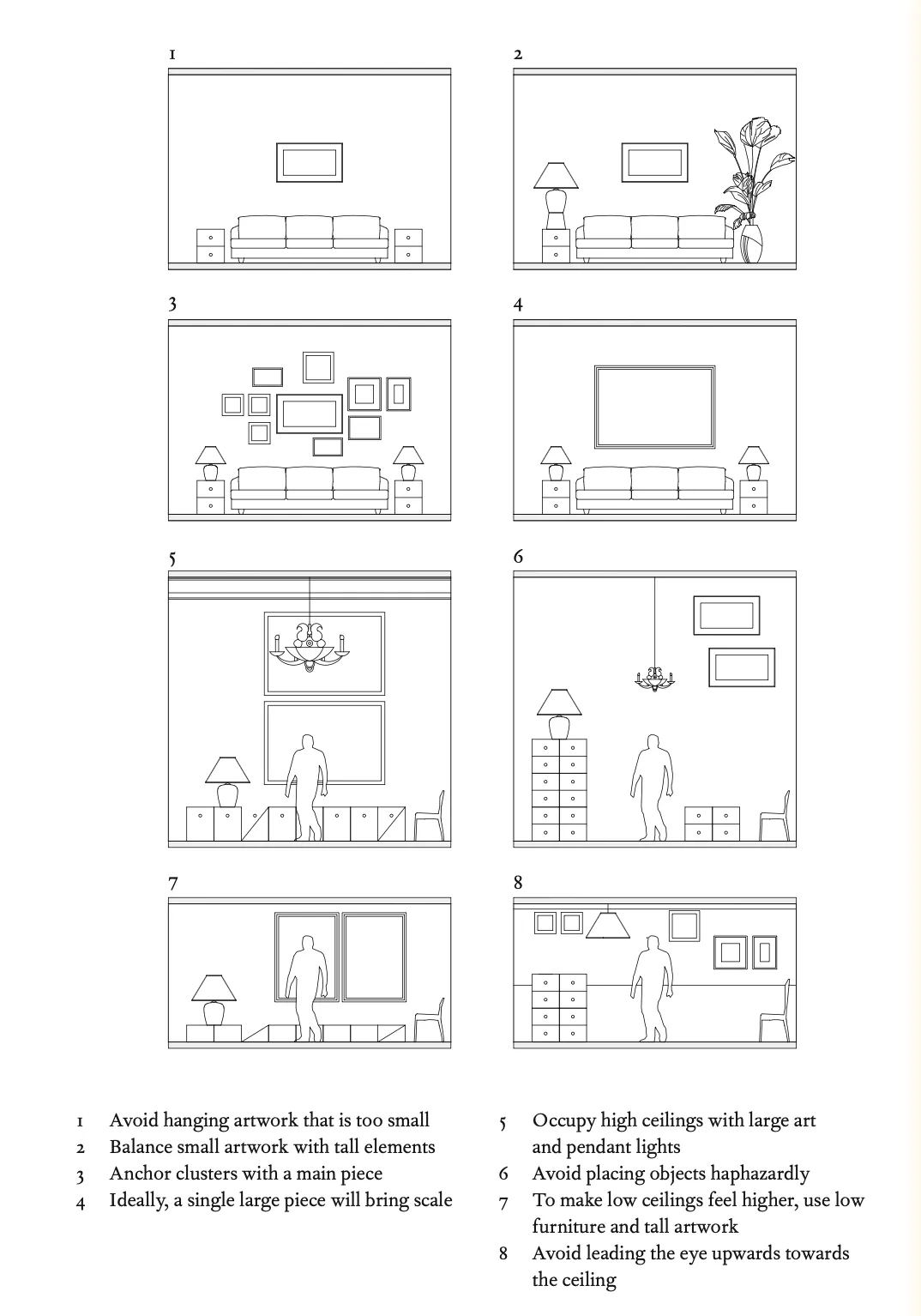
- Hang small pictures over furniture pieces, such as sideboards or cabinets. If you have a larger wall, hang them in clusters or grids with a single anchor image in the centre of the cluster. The general height of each composition should be eye level. If the furniture is too high to achieve this, do not hang anything over it.
- Hang these centrally over a low piece of furniture, or centrally in a prominent wall. The height of the image should be such that it is roughly eye level.
- Items on the wall do not actually take up physical space, but give the impression of scale. This is why the general rule is that if you want to make a space feel bigger, you should use bigger artwork. This will work only with objects that you hang – if you cover an entire wall with a mural, the mural becomes part of the room, and will not give the same sense of scale.
- To heighten ceilings, use tall, narrow artworks (in portrait format). The vertical, rectangular frame evokes the wood element. Tall lamps or sculptures can extend the height of a ceiling as well. You can use these instead of tall plants.
- To widen a room, use horizontal, landscape pictures, which reference the earth element. You can place long centrepieces on dining tables to give a sense of length, too.
- Objects such as round artworks or clocks have the same condensing qualities as metal, and draw the eye towards the centre. Hang these symmetrically over an object such as a fireplace. A circular object, such as a round fruit bowl or bulbous vase, in the middle of a coffee table provides a strong anchoring factor.
- Triangular and wavy, irregular wall pieces are less common, but they refer back to their respective elements, such as fire and water.
- If you’re afraid of painting your walls colours other than white, place colourful objects around the room in the form of hanging art, sculptures or even throws. However, practise restraint: keep the composition balanced and complementary. The colourfulness of a space is less about the variety of colours you have, and more about the contrast between each colour.
5.5 Mirrors and crystals
Mirrors reflect and crystals refract, and both have the ability to control light. Light and movement, as we know, are a source of energy, and being able to control, filter and divert this energy gives mirrors and crystals the potential to change spaces.
Mirrors
- Mirrors, unlike pictures, reflect life – they’re not static or interpretive, they’re more like windows and doors. Do not place mirrors where you don’t want movement Chi to come through.
- In places where there is very little movement, mirrors reflect any motion. Often this movement comes from the person in the room – you – which creates a parallel energy.
- Mirrors double whatever they reflect, so position them so that they reflect the good and not where they might reflect the bad, e.g. dining table not stove.
- A mirror can expand the space.
- Shiny black surfaces, such as TVs, give a similar energy to mirrors, so treat them in the same way.
Mirrors are particularly useful in these locations:
- High-energy areas, such as the living room.
- Where there are prosperous items that you want to double, such as food on a dining table.
- A working environment that places you in a vulnerable position (to give you a view of the door).
- Any stale room that needs an injection of life.
Avoid using mirrors in these locations:
- Low-energy areas, such as a bedroom. (If you must have a mirror, ensure you can’t see it from your bed.)
- Outside your home.
- Long corridors, unless you’re reflecting sideways.
- Areas, such as kitchens, with hostile energy.
The qualities of your mirror:
- A mirror must have a regular shape and be able to reflect your full image without any gaps, which means it should also be tall and high enough to reflect your face.
- Choose a mirror that is clean, with no cracks and no distortions.
- Do not use divided mirrors, such as mirrored tiles.
- Be aware that concave mirrors can absorb bad energy and convex mirrors can expand energy without reflecting it.
How and where to hang your mirror:
- Do not hang a mirror too high or it will make you feel ungrounded.
- A mirror that’s hung too low will force you to bend down to see your reflection, which can make you feel suppressed.
- Use mirrors to reflect light and bring chi in to deep, dark corners.
- If your mirror sits on an angled wall, be mindful of what it will reflect.
- Avoid positioning a mirror behind you, which will make you feel vulnerable to other people watching you over your shoulder.
Crystals
There are two forms of Crystals:
- clear, multi-faceted glass-like objects
- hewn mineral rocks
Apart from Jade (evoking Wood), they were not commonly used to any effect in classical Feng Shui.
Clear Crystals These are almost like mirrors. Always keep them clean and sparkling and they will serve to reflect and disperse light, creating beautiful rainbows across the room.
How to hang clear crystals
- Where there is excessive Chi, such as at doorways that open on to staircases or beds, hang crystals to disperse light and energy.
- In stagnant areas, such as windowless rooms, crystals bring movement and energy.
- Crystals in the middle of tables or consoles draw in energy.
Mineral crystals These come in all shapes, sizes, colours and textures. Observe their visual qualities and focus on how they make you feel before deciding which to position in a space.
5.6 Water
Bringing water into your home
- Water should always be moving. Stagnant water signifies decay.
- Water destroys when it is in the wrong position, so avoid having water in unnatural locations.
- Water destroys when it is in the wrong position, so avoid having water in unnatural locations.
- Plants offer the same assurance of wealth as does water. Shiny blue, glazed tiles or pottery (with the ripply, reflective surface) can create the impression of water. Calming images of lakes or waterfalls, rather than stormy seas, are also alternatives.
5.7 Indoor plants
- The first rule is that you must be able to care for plants. It’s better to have no plants at all, than to have dead plants!
- Plants can soften the straightness of long corridors and soften windows with too much light.
- Plants are particularly good for the entry area of a home, as they show that your home is located on fertile ground where life will flourish.
- For living and dining areas, avoid scattering plants all over these spaces. Instead, form clusters located close to the windows.
- The best plants are full and luscious with broad green leaves.
- Avoid cacti and plants with pointed leaves.
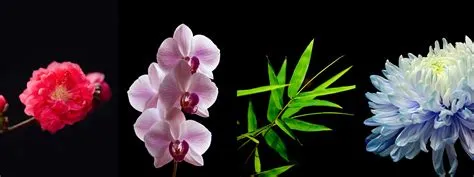
- Chinese culture specifically upholds four notable plants, known as the Four Gentlemen:
- plum blossom - demure resilience, represents hope in winter.
- orchid - hardy yet graceful; represents spring taking hold.
- bamboo - strength and growth; represents summer in full energy.
- chrysanthemum - represents virtue and growth for the transitional season of autumn, but also death
- Avoid fake and dead plants.
- Hanging mobiles, sculptural lights, a bowl of fruits and feathers can serve as alternatives.
·fin·