Shakespeare’s Trolius and Cressida: some personal thoughts
Lechery, lechery, still wars and lechery; nothing else holds fashion. A burning devil take them!
Words, words, mere words, no matter from the heart.
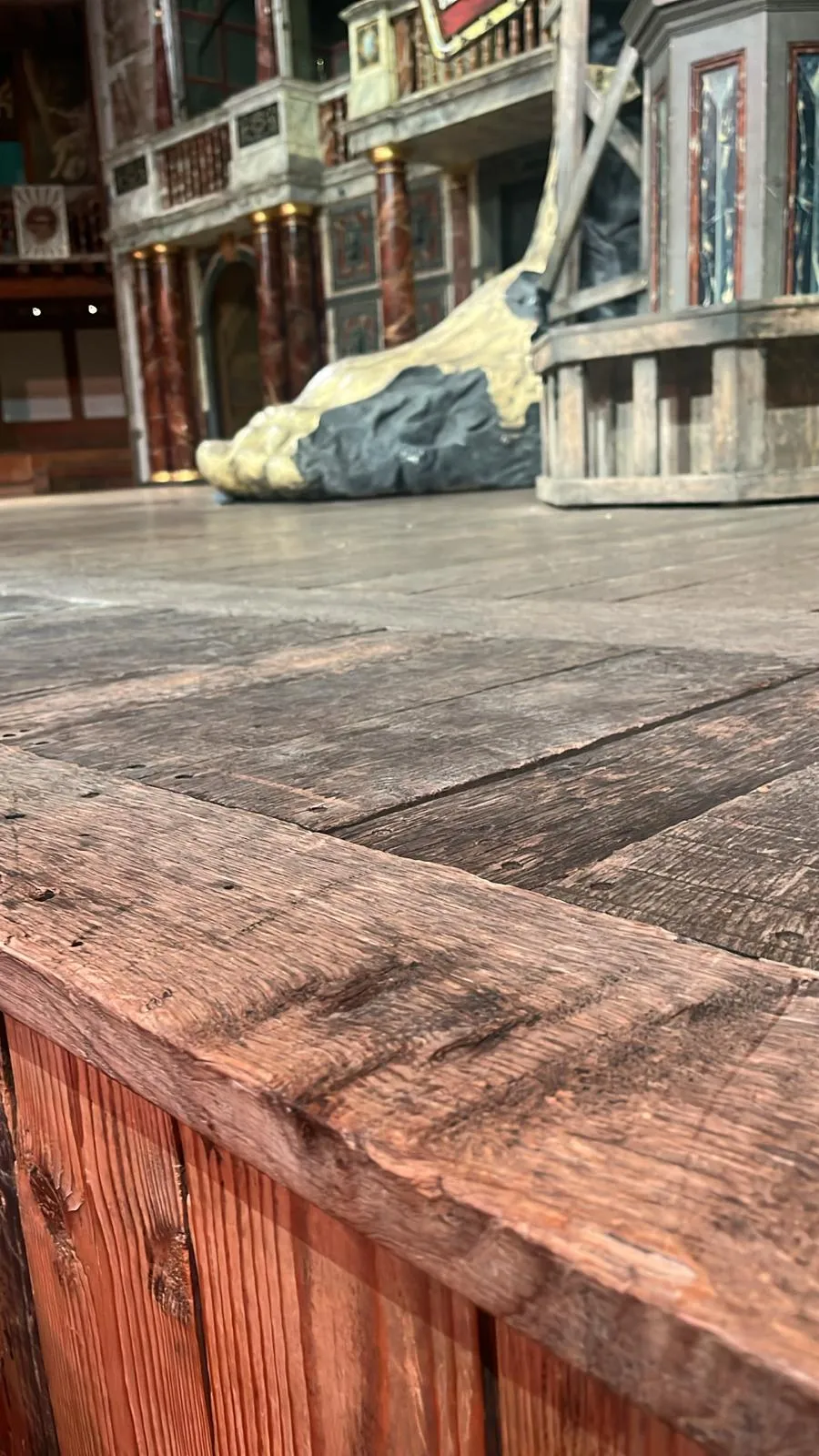 Cameras are prohibited during the show. This is a photo before the play began where I was standing in the pit.
I went to see Shakespeare’s Trolius and Cressida at the Globe last Tuesday night with my buddy. I’m no expert on theatre nor Shakespeare, but I fell into a social pattern of visiting productions at the Globe with my mate. I recognise the importance of being literate to these things. Without a knowledge at a basic level, we are illiterate to what comes afterwards in terms of culture. Shakespeare has left a defining impact upon other influential writers and artists after him. A rose is no longer a rose after Shakespeare.
With that being said, I thought I would use this space to record some thoughts chiefly for people who know me personally, but inevitably, like any recorded medium, anyone else who may encounter this.
Taking advantage of this period of gilded unemployment following my PhD submission on 13th September and waiting for my viva, I spent the day in bed wreading the Arden edition of the play and stop-start watching a very competent US college production on YouTube in the background. Wreading is my expression for when you read and annotate at the same time. I always keep a pen and highlighter at hand all the time. I even keep refills in my bag pocket in case they run out while I’m out.
So here are some extracts I highlighted and marginalia. Like I said, I ain’t no expert - just an ordinary bod trying to make sense of it all, not just what I read, but the world around me and within.
——————————————--------------------------------------------------------------------
On Game
Women are angels, wooing;
Things won are done; joy’s soul lies in the doing.
That she beloved knows naught that knows not this:
Men prize the thing ungained more than it is.
That she was never yet that ever knew
Love got so sweet as when desire did sue.
Therefore this maxim out of love I teach:
‘Achievement is command; ungained, beseech’.
Then, though my heart’s contents firm love doth bear,
Nothing of that shall from mine eyes appear.\
Cressida says this to her uncle Pandarus near the beginning. In the production, Pandarus was an aunt.
Here is my paraphrasing based on the Arden notes: Women are celestial and celebrated beings when being wooed. It’s in the pursuit where pleasure lies. Once achieved, the target loses their attraction. So play hard to get despite your own attraction as a woman to the man…
On virtue and order
Although the speeches of the Greek leaders, and Ulysses in particular, when read on page appear wise, both the college production and the Globe productions delivered them as insincere rhetoric by those practised in the art.
Thinking about Ulyesses’ Troy, yet upon his basis…, I noted how perhaps in premodern times an eclipse is a warning about virtue becoming dim, so that it was indistinguishable from wrongdoing.
Force should be right; or rather, right and wrong,
Between whose endless jar justice resides,
Should lose their names, and so should justice too.
Then everything includes itself in power,
Power into will, will into appetite; And appetite, an universal wolf,
So doubly seconded with will and power
Must make perforce an universal prey
And last eat up himself.
According to the notes:
Justice resides somewhere between
competing claims and is arrived at through
a prolonged jar or discord of opposing
viewpoints. Then all virtuous qualities like
right, wrong and justice become simply
a question of who is most powerful;
power in turn grows self- willed and self-
indulgent, leading to limitless debauchery
and greed.’
"To include” is to terminate
(everything terminates in power) or to
enclose
This reads as both a condemnation but also a strategy.
On Wisdom in War
Also Ulysses:
They tax our policy and call it cowardice,
Count wisdom as no member of the war,
Forestall prescience, and esteem no act
But that of hand. The still and mental parts,
That do contrive how many hands shall strike,
When fi tness calls them on, and know by measure
Of their observant toil the enemy’s weight –
Why, this hath not a finger’s dignity.
They call this bed-work, mapp’ry, closet war;
So that the ram that batters down the wall,
For the great swinge and rudeness of his poise,
They place before his hand that made the engine
Or those that with the fineness of their souls
By reason guide his execution.
On UFC
Nestor:
Though’t be a sportful combat,
Yet in this trial much opinion dwells.
It looks bad for a nation if its finest fighter is immoral whether he wins or loses.
The counsel of the Greek generals and the counsel of Priam and his sons must have been intended to draw comparisons.
Doubt as a Source of Wisdom
Hector:
The wound of peace is surety,
Surety secure; but modest doubt is called
The beacon of the wise, the tent that searches
To th’ bottom of the worst.
Troilus characterises the senses, rather than reason, as mediating between will and judgement
I take today a wife, and my election
Is led on in the conduct of my will,
My will enkindled by mine eyes and ears,
Two traded pilots ’twixt the dangerous shores
Of will and judgement.
Compare this to Ulysses’ more “reasoned” approach.
🚨Spoiler alert:
I think throughout the work there is a tension familiar from my readings and study of the history of ideas in the medieval caliphate, that being between Reason and Revelation in trying to know what is True, Right and Good.
Hector:
Now, youthful Troilus, do not these high strains
Of divination in our sister work
Some touches of remorse? Or is your blood
So madly hot that no discourse of reason,
Nor fear of bad success in a bad cause,
Can qualify the same?
Condemnation of Pride
Agamemnon:
He that is proud eats up himself.
Pride is his own glass, his own trumpet, his own
chronicle; and whatever praises itself but in the deed
devours the deed in the praise.
On Merit of Fear guided by Reason
Cressida:
Blind fear, that seeing reason leads, finds safer
footing than blind reason, stumbling without fear. To
fear the worst oft cures the worse.
Condemnation of Words not matching Actions - whether Lovers or Enemies
Cressida:
They that have the voice of lions and the act of hares, are they not monsters?
I really like that line.
Passion pollutes reasons, and a bad uncle leads his niece astray.
Pandarus is a dayyūth…
The portrayal of Cassandra as an anti-war teenager was clever but I prefer the enchanted prophetess.
Troilus: ...But alas,
I am as true as truth’s simplicity,
And simpler than the infancy of truth.
Cressida: In that I’ll war with you.
Troilus: O virtuous fight,
When right with right wars who shall be most right!
True swains in love shall in the world to come
In Love, Troilus appeals to Reason; in War, to Passion. Ulysses, appears to be the opposite. Virtue is in the balance.
The Salutary Response to Pride is More Pride
Ulysses:
Pride hath no other glass
To show itself but pride; for supple knees
Feed arrogance, and are the proud man’s fees.
As for your Lord’s blessings, speak
Ulysses:
That no man is the lord of anything,
Though in and of him there be much consisting,
Till he communicate his parts to others
No Homo, Bro…
Although it may historically defensible to say Achilles and Patroclus may have been lovers, I don’t think the texts makes that explicit. On stage the two characters kissed as lovers and Patroclus was given a camp demeanour.
Patroclus:
Sweet, rouse yourself, and the weak wanton Cupid
Shall from your neck unloose his amorous fold
And, like a dew- drop from the lion’s mane,
Be shook to air.
The notes say: Patroclus appears to be urging Achilles to conquer his enervating passion for the Trojan Polyxena and the resulting conflict of loyalties that compromise him as a warrior, not to give up his attachment to Patroclus. If only Achilles will fight manfully, the speaker argues, his male friendship with Patroclus will not be under suspicion.
Cross-Cultural Concepts
Frequently, I encounter in ancient texts tropes I find mentioned later in the Quran and Hadith. I highlighted many of these in my reading of Plato’s Republic. Here one from the T&C notes:
Genius in classical religious belief, ‘the tutelary god or attendant spirit allotted to every person at his birth, to govern his fortunes and determine his character, and finally to conduct him out of the world’
This is similar to the Hadith about an angel writing a baby’s fate in the womb.
I also noted a phenomenon to do with sleeves that chimed nicely with something I stumbled across during my reading of Ibn Rajab’s biographical dictionary of historic Ḥanbalītes. There’s mention of Medieval Muslims using their sleeves as storage, such as books. One’s mind is really exercised how that was done and whether ’sleeve’ is the correct approximation for the medieval Arabic usage of the term. In any case, there is an exchange of tokens between the lovers as Cressida is taken to the Greek camp as part of a hostage exchange. Troilus gives her a sleeve, a detachable cuff according to the notes, but on stage more like a boxer’s sweat rag worn around the neck.
The Greater Jihad…of the Self
Again, I think that we are seeing this conflict between what it means to be true and virtuous, neither naive, nor cynical, and it’s played off really appealing in the text. (Sorry, it’s easier to share a screenshot here)
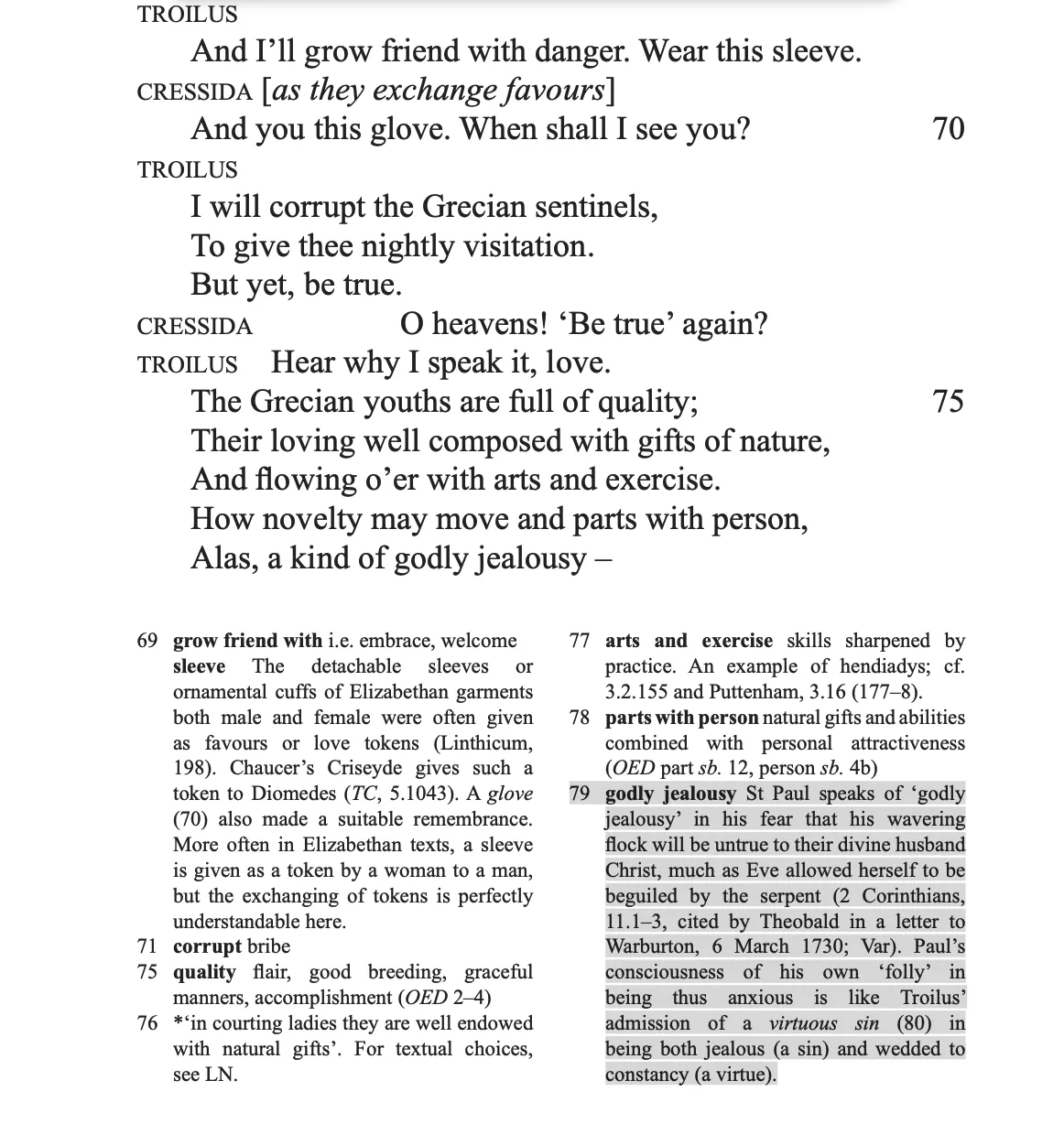
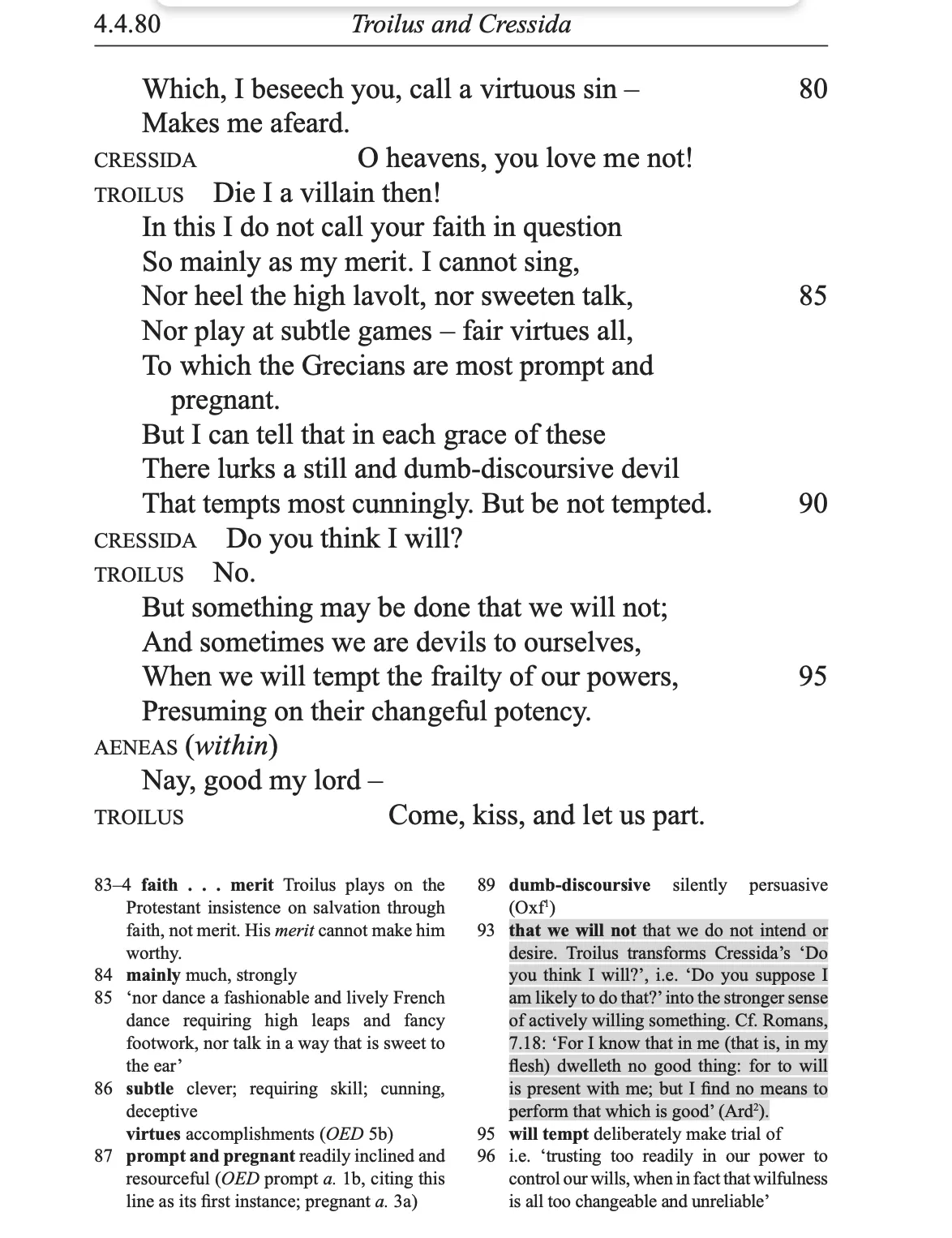
And again, that interplay of Faith and Works for salvation. In the Sunni Islamic tradition, works do not enter one into paradise; it’s God’s mercy. Works are fruits of Faith. I personally don’t like the use of “faith”; it implies irrationality, which is at odds to be in accord with the True Order of things, which must be justified rationally.
I noted: Worldly claims are not pursuits of pure justice; there can be an overlap between claimant and defendant.
Hector spares Ajax from a total TKO in their fight since they are cousins.
From the notes:
Hector is wise enough to fear the blind folly personified in Atē, the goddess of mischief through whose agency the Olympian gods could induce in a hero the self-deluded infatuation and hubris that would lead to rash destructive deeds and a fated downfall.
Troilus:
But still sweet love is food for Fortune’s tooth.
I liked that too!
Troilus (while Ulysses gives him a secret tour of the Greek camp to see Cressida with Diomedes):
There is between my will and all offences
A guard of patience. Stay a little while.
Notes: i.e. ‘My self- control will guard me against translating my anger into offenceful action’. Troilus can barely control with his reason the hot blood that, as Ulysses observes at 43, threatens to break out in irrational behaviour. All offences could also mean ‘anything that might be done to offend me’; Troilus will not allow any insult to break down his promise to remain quiet.
Pain belies Reason, just like Pleasure, Love and Hate
Troilus:
This she? No, this is Diomed’s Cressida.
If beauty have a soul, this is not she;
If souls guide vows, if vows be sanctimonies,
If sanctimony be the gods’ delight,
If there be rule in unity itself,
This is not she. O, madness of discourse,
That cause sets up with and against itself!
Bifold authority, where reason can revolt
Without predition, and loss assume all reason
Without revolt! This is and is not Cressid.
Within my soul there doth conduce a fight
We know affection can be fickle. Does Troilus fight for love or wounded pride? God’s jealousy is more perfect, according to the traditions in the heritage of Sunni Islam. There’s a sense of betrayal in cheating. And the betrayal of a patient God is constant. Like spurned lover, attention will be retrieved, even it may be through the affliction of pain too. The pain of separation is greater. But Achilles’ vengeance is dishonourable.
“Allah is Pure and only accepts the pure”
Cassandra:
The gods are deaf to hot and peevish vows.
They are polluted off’rings, more abhorred
Than spotted livers in the sacrifice.
Troilus:
This foolish, dreaming, superstitious girl
Makes all these bodements.
Thoughts on the Production
Thersites was played strong as some kind of abused crack whore, and dominates the entire play, and the actress doubled as Helen too, abused in a different way, like a Hollywood starlet. The women all appear suffering some kind of PTSD or Stockholm syndrome, unwilling accomplices to the male passions.
Hector and his internal conflicts were played strong on stage too. This wasn’t a tick-box casting like it felt for some previous productions, which is a disservice to the genuine strengths of those actors.
Andromache and Priam are dropped entirely from the production.
Diomedes was played by a proper gigachad on stage. Standing as I was right in front of the stage, his presence was genuinely menacing when he got close.
The scene of the Greeks kissing Cressida was very uncomfortable both on page and stage: very rapey. For me, Cressida and Helen fall for their new men not out of love, but fear.
The Globe production ended with a note of cynicism. Love, forever a redeeming force for the world’s pain and ugliness, instead is seen as the force that causes that very pain and ugliness. From my reading of the text, I noted the following:
- Enemies can respect one another and be honourable in resolving their disagreement, not for a personal gain, but manifestation of the truth, cf. the Ajax-Hector fight scene; the mutual respect and hospitality between the Greek and Trojan princes for their feast.
- This is better than friends not telling the truth of each other's thoughts to one another, like how Cassandra is ignored, or Hector prefers family loyalty over reason.
- True treachery is not treachery to family, love, or cause, but to Truth, Reason, Revelation, Virtue.
- But service to Truth, Reason, Revelation, Virtue and Beauty are betrayed and made ugly by personal moral shortcomings. The greatest struggle is to overcome that. If you don't make an effort to correct yourself, God through the Universe will correct you. Truth, Beauty, Reason, Virtue, refuses the impure, stained, (morally) deformed, those who are wilfully blind to their shortcomings, to serve them.
- Truth, Beauty, Reason, Virtue prefer the humbled sinner over the proud holy man.
- It is for Truth itself to reward the truthful, not for the truthful to assume themselves virtuous by fulfilling an obligation.
- Be guided by conscience, not feelings; principles, not passions. Use passions as fuel instead once weaponry is well-engineered.
- Hardships are divine harvests of men’s virtues.
- True strength is in remaining rational, truthful and virtuous; true weakness is moral failing.
Like I said, I ain’t no expert, but these are just thoughts that came to mind during reading and viewing.